
Executive summary
Most Indian organisations still plan their workforce in job titles and headcount. That worked when roles stayed stable for years. It works less well when employers expect close to two-fifths of the skills their people use today to change by 2030: 38 per cent in India, 39 per cent globally [1]. A title tells you what someone was hired to do. It tells you very little about what they can do next.
The World Economic Forum's employer survey makes the scale plain. If the world's workforce were 100 people, 59 would need training by 2030; 29 could be upskilled in their current roles, 19 could be upskilled and moved elsewhere in their organisation, and 11 would be unlikely to get the training they need [5]. Upskilling is now the most common workforce strategy, planned by 85 per cent of employers [2].
This paper argues that Indian employers should plan around skills rather than titles: describe work in skills, know what skills they already have, decide which to build, buy or redeploy, and hire on evidence of ability rather than on degrees alone. Employers in India are already ahead of the world on two of these practices [3]. The task now is to make them systematic.
Key findings
Building on our earlier work
In Future HR Mandates: Who Carries Them we described workforce planning as a mandate that HR shares with finance and business leaders. In HR in the Age of AI we looked at how AI changes the work HR itself does. This paper takes the next step: how to plan the workforce when the content of jobs is changing faster than job titles can keep up.
The evidence at a glance
Employers expect AI and technology to create about 170 million jobs worldwide by 2030 and displace about 92 million, a net gain of 78 million [5]. The headline number hides the real churn: tens of millions of people moving between roles, and many more whose current role changes around them. Employers are responding with a mix of strategies, and most are pursuing several at once.
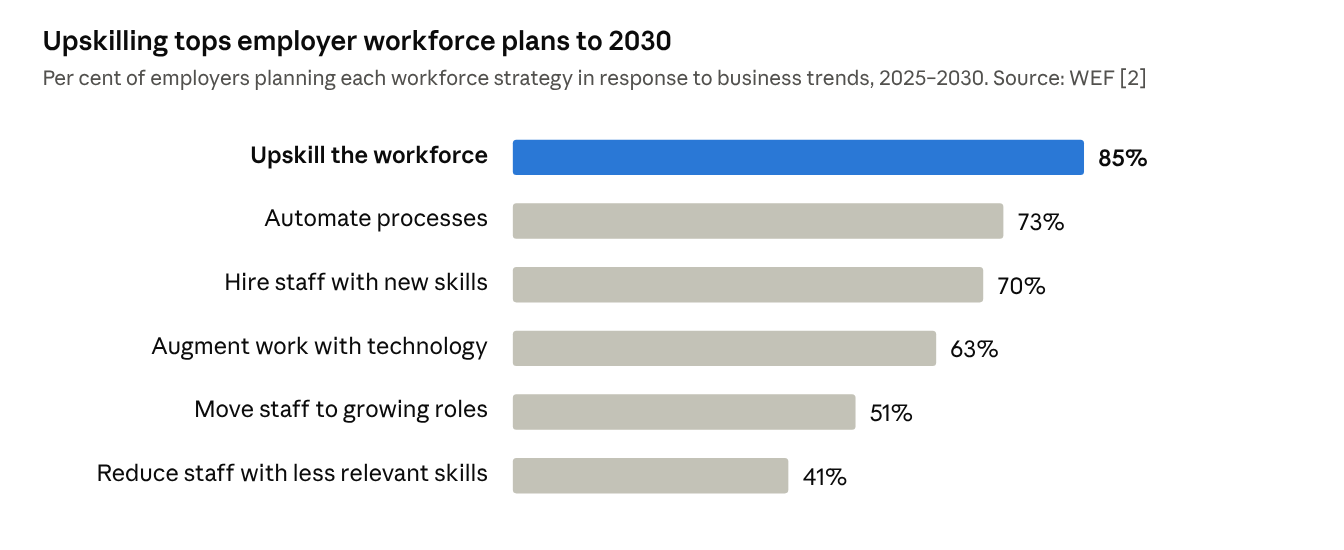
Source: WEF [2].
Read the chart from both ends. Upskilling is almost universal, but four in ten employers also expect to let go of people whose skills fade. Which group an employee ends up in often depends less on their potential than on whether their employer can see their skills clearly enough to move them. That is a planning problem, and it starts with data.
Deloitte's 2026 survey of more than 3,000 business and HR leaders suggests the shift is under way. 61 per cent of organisations now say they deploy workers based on tasks, skills and outcomes, against 33 per cent that use job- or position-based models [12]. Execution lags ambition, though: 88 per cent of leaders call orchestrating people, skills and resources very or extremely important, but only 7 per cent say they are making great progress [12]. And cutting first carries its own risk. Of the third of leaders who have let workers go because of AI, 57 per cent say they have since come to question that decision [12].
Which skills matter
The skills employers value most are not only technical. Analytical thinking tops the list, followed by resilience, flexibility and agility, and then leadership and social influence [9]. AI and big data, networks and cybersecurity, and technological literacy are the fastest-growing skills, but human skills such as creative thinking, curiosity and lifelong learning, and leadership are rising alongside them [5][9].
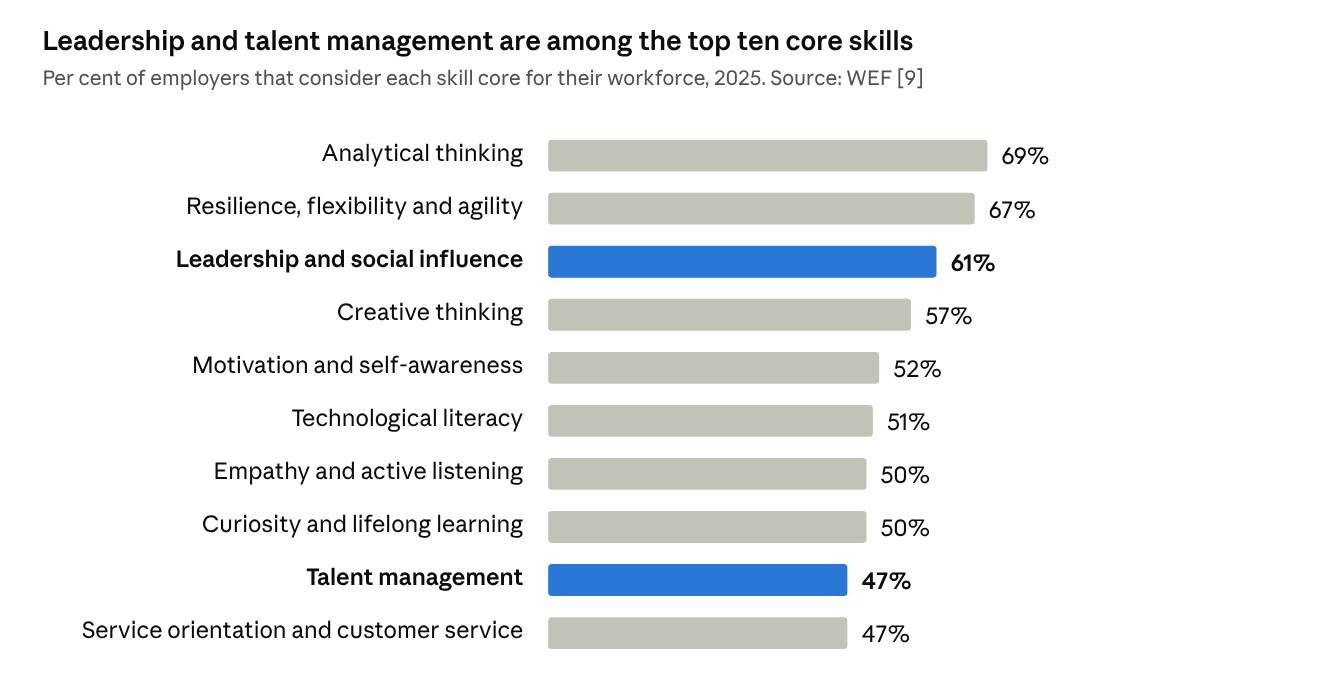
Source: WEF [9].
Two of these skills, leadership and talent management, are the skills of managing people. That links skills planning directly to the manager role, which we examine in The Manager Squeeze. A skills plan that only counts coders and data analysts will miss the capability that makes every other skill productive.
The pressure also shows up at the entry level. In Deloitte's 2025 human capital research, two-thirds of managers and executives said most recent hires were not fully prepared, with experience the most common shortfall, even as new technologies take over rote tasks once done by junior staff [7]. If junior roles shrink, organisations need new ways to build experience, not just new ways to screen for it.
India's head start
Employers in India already think beyond the degree more than their peers elsewhere. They expect increased digital access to be the biggest force shaping jobs in the country by 2030, and they name Big Data Specialists, AI and Machine Learning Specialists, and Security Management Specialists among the fastest-growing roles [3]. To meet that demand, they are far more likely than employers globally to look to diverse talent pools and skills-based hiring [3].
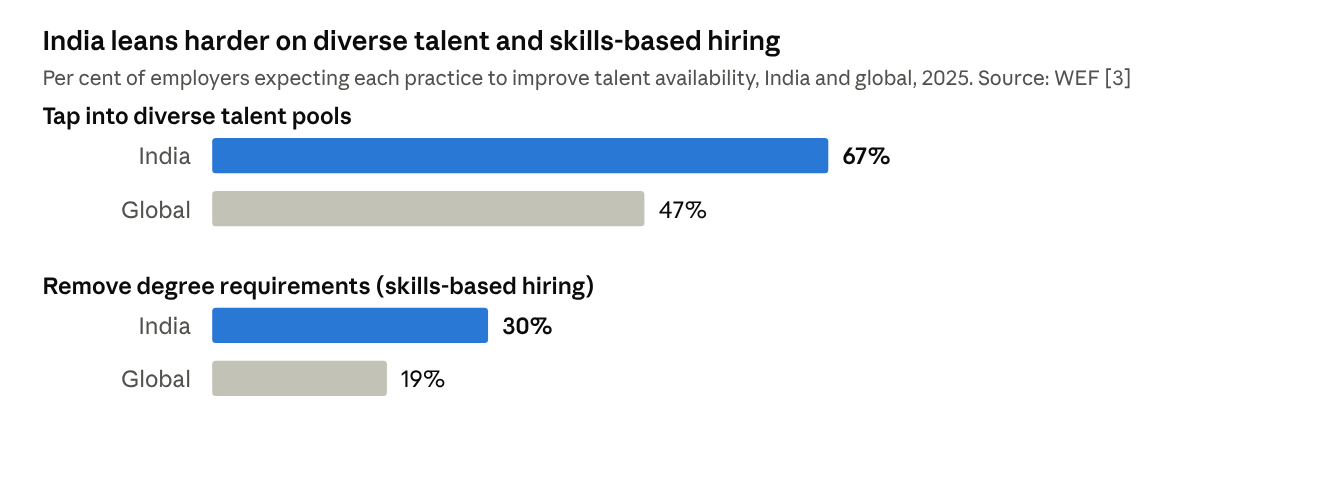
Source: WEF [3].
India's companies also take a more active role in AI learning. Coursera data analysed by the World Economic Forum show India and the United States leading enrolment in generative AI courses; in the US, demand comes mainly from individuals, while in India, corporate sponsorship plays a significant part [4]. Indian employers, in other words, already pay for skills. The gap is in knowing what that spending buys. In our experience, few Indian organisations can say with confidence which skills their people hold today, or how that has changed after a year of training [11].
From titles to skills: a practical path
A skills-based plan does not need a large transformation programme. It needs a sequence of decisions that each add value on their own [11].
AI can help at almost every step, from inferring skills from job descriptions and project records to matching people to roles. But the judgement on what skills the organisation needs, and how fairly it moves people, stays with leaders. We discuss that balance further in HR in the Age of AI.
A note on the UAE
Employers in the UAE expect slightly more skills disruption than the global average, and an especially fast move to technology: they project that 43 per cent of work tasks will be delivered mainly by technology by 2030, against 34 per cent globally, and 87 per cent expect rising demand for technological literacy [10]. With a largely expatriate workforce and Emiratisation targets to meet, skills planning in the UAE must also cover how local talent is built, which we explore in The UAE Talent Market.
About this research
Method. This paper is a synthesis of published research and Interloop's practitioner view. Figures were checked against the full text of the World Economic Forum's Future of Jobs Report 2025, including its economy profiles, and against the original LinkedIn and Deloitte releases. Each statistic is numbered in the text and listed under References.
Limitations. The World Economic Forum figures reflect what employers expect, not what has happened, and come from a survey of large employers. Measures of skills change differ between sources: the World Economic Forum asks about workers' core skills, while LinkedIn looks at the mix of skills used in jobs, so their figures are not directly comparable. The playbook reflects our practitioner view.
Credits, copyright and permissions
© 2026 Interloop Consulting. All rights reserved. You may share this paper in full, with credit to Interloop. Please do not edit it, use excerpts commercially or republish it without our written permission.
Third-party research. Statistics from other organisations are quoted for research, commentary and review, and remain the property of their publishers. Every exhibit in this paper is Interloop's own visualisation of published figures; none reproduces an original chart.
References (12)
- [1]World Economic Forum (2025). Future of Jobs Report 2025, Figure 3.2, p. 34 (expected skills change by economy). © 2025 World Economic Forum. weforum.org
- [2]World Economic Forum (2025). Future of Jobs Report 2025, Figure 4.4, p. 52 (workforce strategies). weforum.org
- [3]World Economic Forum (2025). Future of Jobs Report 2025, p. 68 (India). weforum.org
- [4]World Economic Forum (2025). Future of Jobs Report 2025, Box 1.1, p. 11 (demand for generative AI skills, in collaboration with Coursera). weforum.org
- [5]World Economic Forum (2025). Future of Jobs Report 2025, Key findings, pp. 5–6. weforum.org
- [6]World Economic Forum (2025). Future of Jobs Report 2025, p. 50 (talent availability outlook). weforum.org
- [7]Deloitte (2025). "Closing the experience gap through talent development", 2025 Global Human Capital Trends, Deloitte Insights. deloitte.com
- [8]LinkedIn (2025). Work Change Report, 15 January 2025. linkedin.com
- [9]World Economic Forum (2025). Future of Jobs Report 2025, Figure 3.3, p. 35 (core skills) and Figure 3.4, p. 37 (skills on the rise). weforum.org
- [10]World Economic Forum (2025). Future of Jobs Report 2025, Figure 3.2, p. 34, and pp. 68–69 (United Arab Emirates). weforum.org
- [11]Interloop Consulting (2026). Interloop analysis, based on client engagements and internal practitioner discussions, October 2026.
- [12]Deloitte (2026). 2026 Global Human Capital Trends: From tensions to tipping points, "The orchestration advantage", pp. 39, 41 and 42. Deloitte Insights. deloitte.com
Interloop Research Team (2026). From Job Titles to Skills: Planning India's Workforce for 2030. Interloop Research Series on the Future of HR, Paper 6. Interloop Consulting.
This paper is for general information only and does not constitute professional advice. Figures are as published at the time of writing, October 2026. Interloop accepts no liability for decisions made on the basis of this paper.
Continue Reading