
Executive summary
Over the last few years, we have watched HR's job change shape. In our view, the work ahead falls under five mandates, and most growing companies pick them up in the wrong order. Culture and trust find an owner early on. The three design mandates (shaping the organisation, building how work runs and growing capability) are left to chance until the company is well past 500 people.
In this paper, we set out a five-mandate framework and a simple coverage model that rates how well each mandate is usually owned at three stages of growth, on a scale of 1 (unowned) to 5 (built in). The pattern we see is fairly consistent [12]:
Getting this order wrong costs more today than it did five years ago. AI, fast-changing skills and flatter structures are all pushing HR's value towards design work. And the scaling stage, where design is weakest, is precisely when habits get set.
For growing companies in India and the UAE, the answer is not a bigger HR team. It is to name an owner for each design mandate early, and to move routine HR work into well-set-up systems so that the team actually has the time to design.
Key findings
The evidence at a glance
The research we looked at for each mandate tells a similar story. HR's agenda is moving away from running programmes and towards designing how the organisation works.
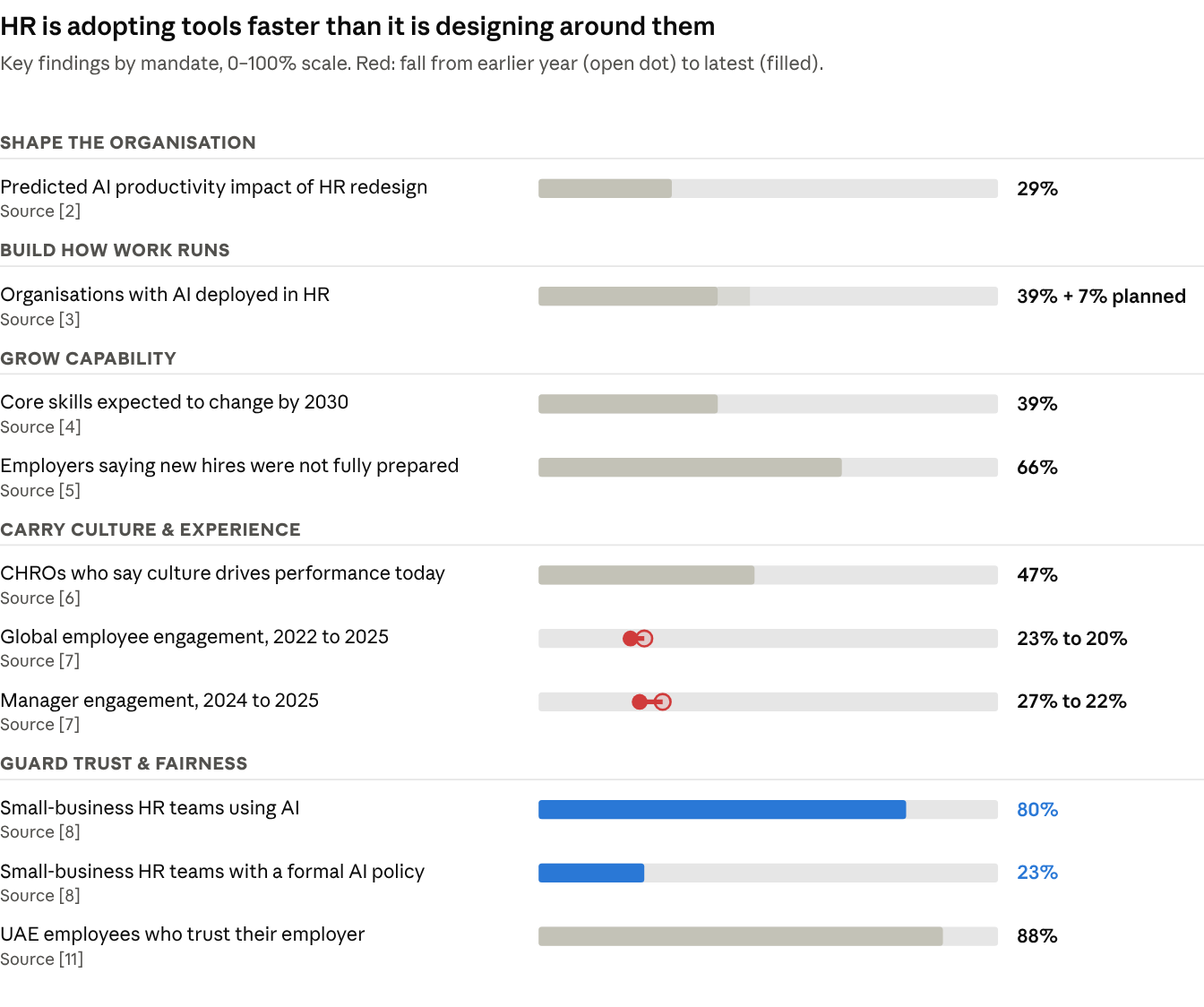
Sources: as numbered, listed under References.
Two things come through clearly in these numbers. First, managers, who carry the culture every single day, are the ones under the most pressure. Second, companies are adopting AI and new tools much faster than they are deciding how work, skills and accountability should fit around them.
The five mandates
We think of each mandate as an outcome HR is answerable for, rather than a process it runs. Three of them are about design and two are about stewardship.
| Mandate | What it means in practice | Type |
|---|---|---|
| Shape the organisation | Structure, roles, spans of control and decision rights that let the business reorganise without starting over | Design |
| Build how work runs | Processes, approvals, data and automation, so routine work runs itself and people handle judgement | Design |
| Grow capability | Hiring and developing for skills, blending employees, contractors and AI into one picture of capability | Design |
| Carry culture and experience | Values, manager quality and the everyday experience of work, kept consistent as the company changes | Stewardship |
| Guard trust and fairness | Fair, transparent rules on pay, data, AI use and conduct, applied the same way for everyone | Stewardship |
The difference is important. Stewardship goes on all the time and shows up in every interaction an employee has with HR. Design work comes in bursts. It needs focused effort, the authority to work across functions, and one person who owns the blueprint.
Interloop's mandate coverage model
The model rates how well each mandate is usually owned at three stages of a company's growth. The ratings are based on our analysis of client engagements and internal discussions among our practitioners [12].
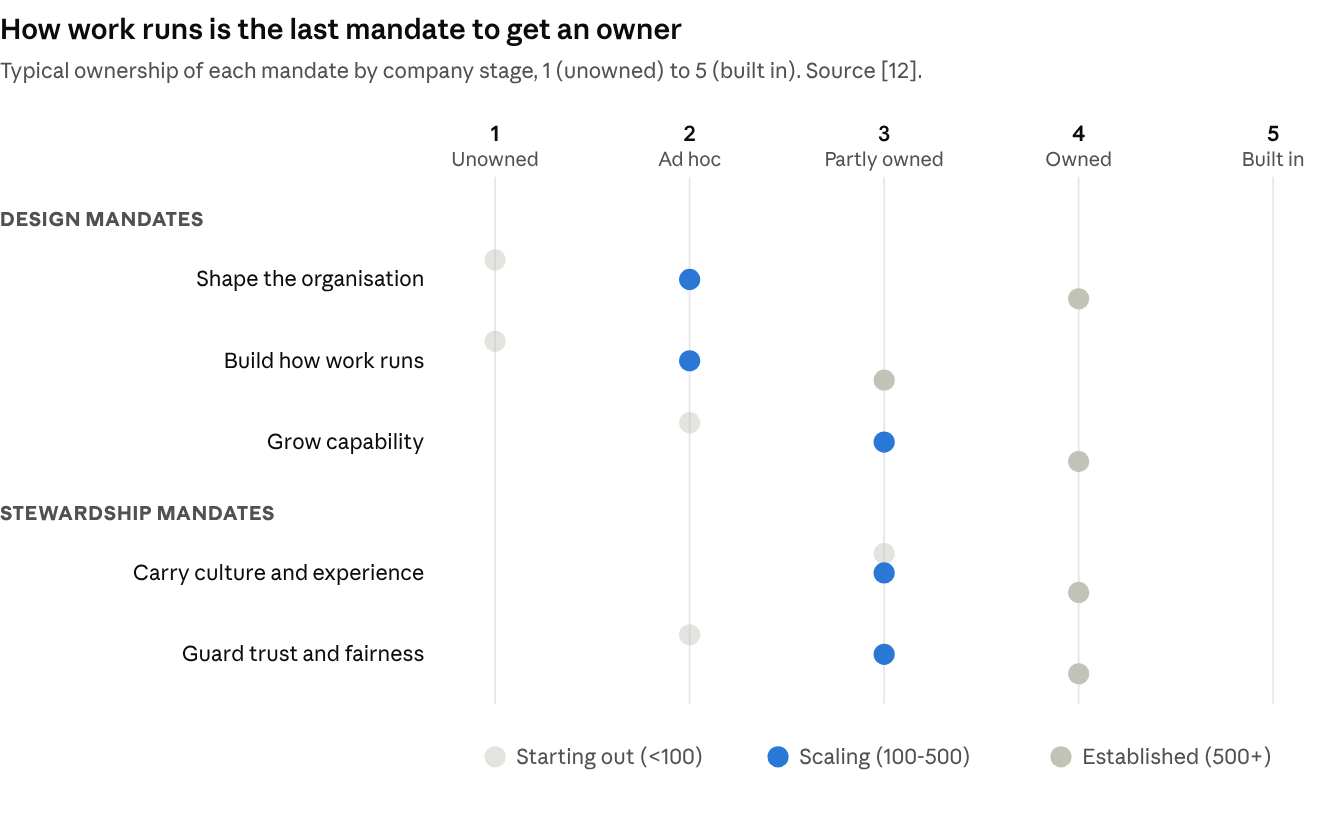
Source: Interloop analysis [12].
| Stage | Typical HR set-up |
|---|---|
| Starting out (under 100 people) | Founder or COO plus one HR generalist; payroll often outsourced |
| Scaling (100–500 people) | An HR head, two to four generalists or HRBPs, a recruiter |
| Established (500+ people) | HR leadership, HRBPs and specialists in talent, rewards, learning and HR systems |
A few things are clear from the model. Culture is the only mandate that has an owner from day one, and that owner is usually the founder. The gap really opens up at the scaling stage. This is when headcount and complexity grow the fastest, and yet shaping the organisation and building how work runs are still handled on the fly. Even at scale, how work runs is only partly owned, mainly because it falls between HR and IT and seldom has one clear owner.
Mandate by mandate
Each mandate matters today for its own reasons, and each tends to slip at a different point in a company's growth.
1. Shape the organisation
Coverage: unowned when starting out, ad hoc while scaling, owned once established [12].
Organisation design has become HR's responsibility because AI is changing what roles actually contain. Companies are cutting or thinning out middle-management layers, partly to save costs and partly because of AI [1]. Gartner's research finds that evolving the HR operating model has the highest predicted impact on AI-driven productivity gains, at 29 per cent [2]. When a company flattens without redesigning, the extra load simply lands on the managers who are left.
Business leaders want HR in the room, but few think it is there yet. Mercer's 2026 global talent research finds that 81 per cent of investors see embedding HR into strategic decision-making as essential for growth, yet only 8 per cent of executives believe their HR function is strategically embedded [16]. Three-quarters of HR functions still run on the familiar three-pillar model of centres of excellence, business partners and shared services, and reinventing that operating model is a 2026 priority for 35 per cent of HR leaders [16]. Shaping the organisation starts with reshaping HR itself.
2. Build how work runs
Coverage: unowned when starting out, ad hoc while scaling, only partly owned even once established [12].
Of the five, this is the mandate that stays behind the longest. AI is going into the easiest workflows first: 27 per cent of organisations use it in recruitment, 14 per cent in employee experience and 2 per cent or less in compliance [3]. The harder workflows, such as approvals, policy rules and data moving between HR, payroll and finance, need someone who understands the process and the system equally well.
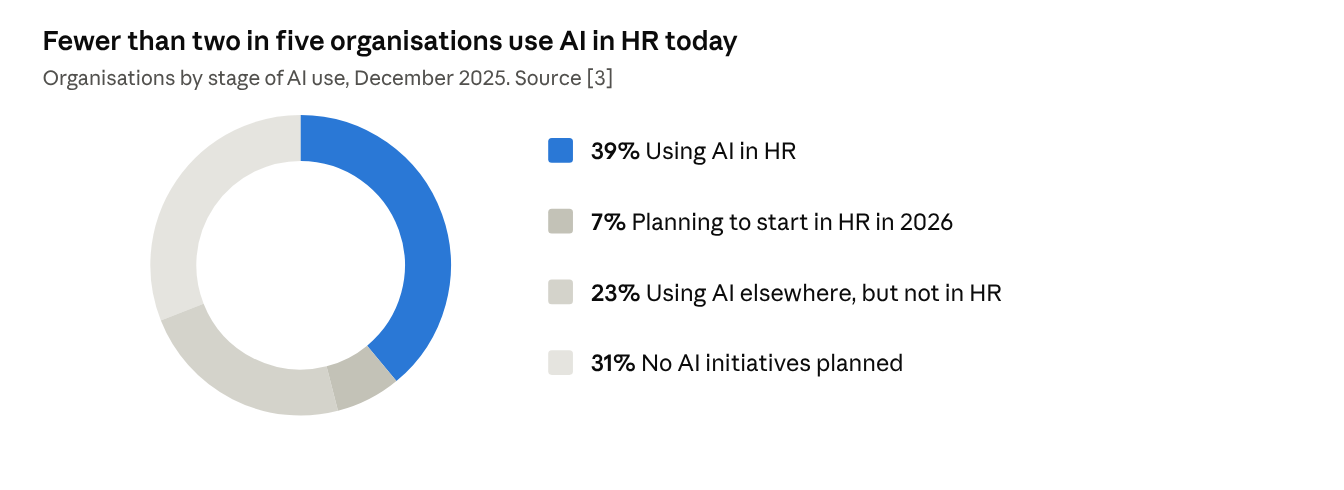
Source: SHRM [3].
Looked at another way, nearly a third of organisations had no AI initiatives planned at all, and close to a quarter were using AI in other functions but not yet in HR [3].
3. Grow capability
Coverage: ad hoc when starting out, partly owned while scaling, owned once established [12].
Employers expect 39 per cent of workers' core skills to change by 2030; the figure is 38 per cent for India and 41 per cent for the UAE [4]. As many as 66 per cent of employers say their recent hires were not fully ready for the role, while nearly 60 per cent of workers feel their organisation gives more weight to degrees and experience than to skills and potential [5]. Hiring for skills needs a common skills language that recruiters, the learning team and managers all use. That makes it a design problem more than a recruitment one.
4. Carry culture and experience
Coverage: partly owned from the start, usually by the founder; owned once established [12].
Companies take ownership of culture earlier than anything else, yet the results are not showing. Only 47 per cent of 222 CHROs surveyed say their culture drives employee performance today [6]. Global employee engagement dropped from 23 per cent in 2022 to 20 per cent in 2025, and manager engagement fell from 27 to 22 per cent in 2025 alone [7]. Employees experience culture through their managers and through everyday processes, and both of these sit inside the design mandates that remain thin.
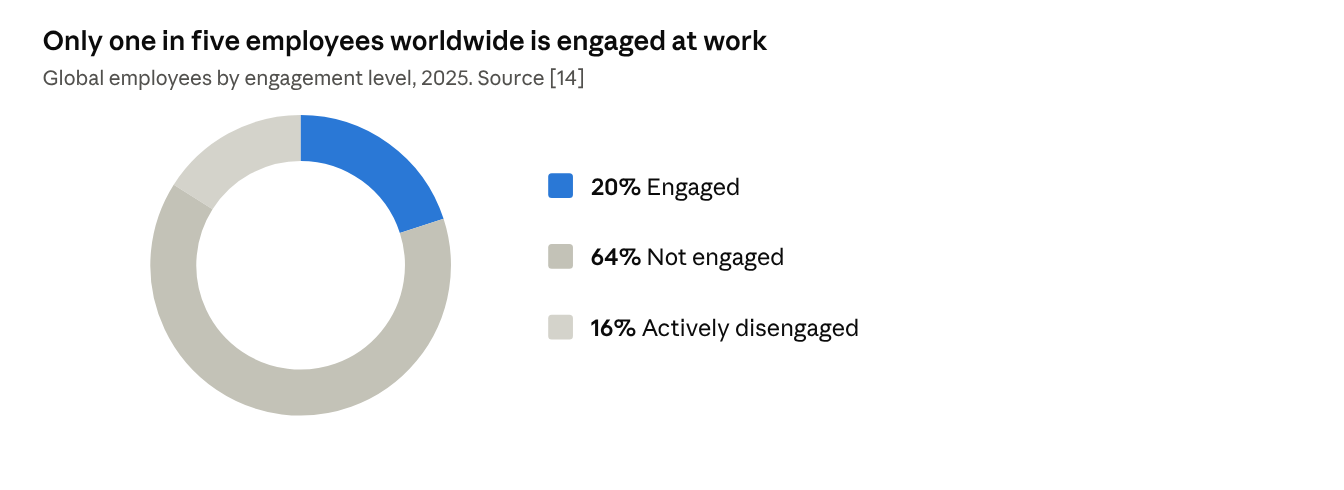
Source: Gallup [14]. Copyright © 2026 Gallup, Inc.
For every engaged employee, there are more than three who are not engaged, and almost one who is actively disengaged [14]. The picture is not fixed, though. In best-practice organisations, 79 per cent of managers are engaged, nearly four times the global average [10].
5. Guard trust and fairness
Coverage: ad hoc when starting out, partly owned while scaling, owned once established [12].
Trust is built or lost in every decision HR takes, whether on pay, hiring, data or disciplinary matters. AI has added fresh pressure. Among small and mid-sized businesses, 80 per cent of HR teams use AI but only 23 per cent have a formal policy for it [8]. Employees, on their part, still trust their employers: the 2026 barometer found the employer to be the only institution that a majority feel is living up to its responsibility to build trust [9]. How HR sets the rules on AI will decide whether that trust is protected or used up, a theme we take further in HR in the Age of AI: What Really Changes.
What it means for growing companies in India and the UAE
Most growing companies we work with in both markets are in the scaling stage, which is exactly where the design mandates stall. With an HR head, a few generalists and a recruiter, the team keeps culture and compliance going, but nobody really owns the blueprint for structure or for how work runs.
India. Gallup's 2026 data show 23 per cent of employees in India engaged at work, slightly above the global average of 20 per cent, but only 17 per cent thriving in their overall lives, half the global figure of 34 per cent [15]. Manager engagement in South Asia fell by eight points in 2025, the largest decline of any region; the region's data are primarily from India, and the share of managers also fell [7]. Gallup's research links lower manager engagement to larger spans of control [10]. We see this often in fast-growing Indian companies. A star performer is made a team lead, but the span of control and the support around the role are never redesigned. This is the very problem the first mandate, shaping the organisation, is meant to solve.
We look at both of these findings in more depth in India's Thriving Gap and The Manager Squeeze.
UAE. The picture here is different. Gallup finds 27 per cent of UAE employees engaged and 55 per cent thriving, both well above the global averages [15]. As many as 88 per cent of UAE employees trust their employer [11]. With workforces drawn from many nationalities, the job is to keep that trust consistent: the same rules on pay, data and AI use, whatever the employee's nationality, visa category or entity.
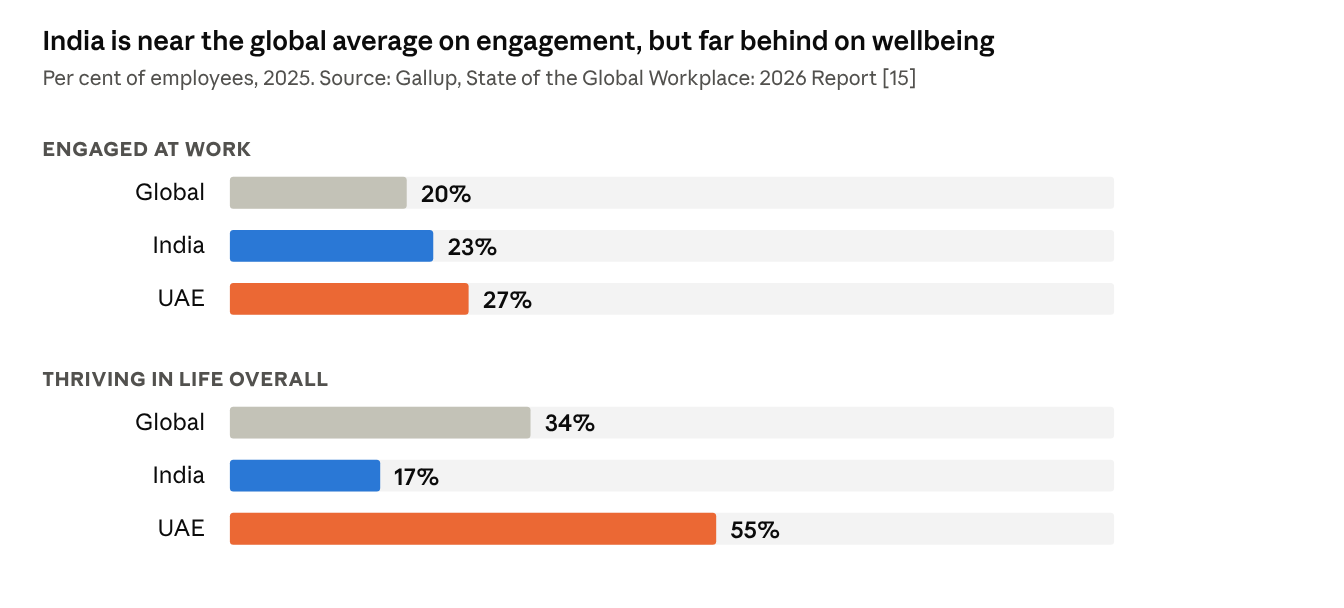
Source: Gallup [15]; comparison arranged by Interloop.
Both markets. Companies that operate across India and the UAE deal with two sets of labour laws, two payroll cycles and two very different talent pools. Getting work to run smoothly across both is as much a systems problem as it is a people problem. It also raises a harder question about where employee data should live, which we look at in Sovereignty in HR Tech: Why Employee Data Should Stay in India.
A practical path to full mandate coverage
In our experience, closing these gaps does not begin with hiring specialists. It begins with an honest look at which mandates are already covered, followed by freeing up time for the ones that are not.
We would suggest sticking to this order. Steps 1 to 3 create the time and clarity that steps 4 to 7 depend on.
About this research
Acknowledgement. This research was inspired by the Future HR Mandates: Role Contribution framework, which maps HR roles against the core mandates of tomorrow's HR function [13]. The idea at its heart, that HR's future work can be split into distinct mandates and each role's contribution to them can be rated, gave us our starting point.
Building on that idea, the five-mandate framework and the coverage model in this paper are Interloop's own. The coverage ratings draw on our client engagements and internal discussions among our practitioners [12].
Method. This paper is a synthesis of published research, combined with Interloop's own practitioner view. Between September and October 2026, we reviewed studies from Gallup, the World Economic Forum, Gartner, Mercer, SHRM, Deloitte, HR Partner and Edelman, and checked each figure against its original publisher's report or release, including the full text of Gallup's State of the Global Workplace: 2026 Report and the World Economic Forum's Future of Jobs Report 2025. Where a figure is available only through a secondary report, the reference says so. Each statistic is numbered in the text and listed in full under References.
Limitations. HR team structures differ a great deal by sector and by company. The coverage model is best used as a starting point for each organisation's own assessment, not as a benchmark. Survey figures come from different samples, regions and years, and are presented side by side for context rather than as a single dataset.
Summary version
Future HR mandates: who carries them — a one-page brief
In our view, HR's future work comes down to five mandates: shaping the organisation, building how work runs, growing capability, carrying culture and experience, and guarding trust and fairness.
Our coverage model suggests that growing companies take these on in the wrong order. Culture has an owner from day one. Shaping the organisation and building how work runs are handled on the fly right through the scaling stage of 100 to 500 people, and how work runs is still only partly owned at 500 and above [12].
This matters because HR's value is shifting towards design work:
Where to begin: score your team's coverage of the five mandates, name an owner for each design mandate early, and move routine HR work into well-set-up systems so that the team has time to design.
Interloop Research Team
Credits, copyright and permissions
© 2026 Interloop Consulting. All rights reserved. You may share this paper in full, with credit to Interloop. Please do not edit it, use excerpts commercially or republish it without our written permission.
Third-party research. Statistics from other organisations are quoted for research, commentary and review, and remain the property of their publishers. Every exhibit in this paper is Interloop's own visualisation of published figures; none reproduces an original chart. Where we have arranged or compared figures, such as India and the UAE against global averages, the exhibit says so.
References (16)
- [1]Deloitte (2025). 2025 Global Human Capital Trends: Turning tensions into triumphs. Press release, 24 March 2025. deloitte.com
- [2]Gartner (2025). Top HR Trends and CHRO Priorities for 2026. Survey of 426 CHROs across 23 industries and four regions. gartner.com
- [3]SHRM (2026). The State of AI in HR 2026. Survey of HR professionals, December 2025. shrm.org. Practice-area figures as reported by Axis Intelligence.
- [4]World Economic Forum (2025). Future of Jobs Report 2025, pp. 5–6 and Figure 3.2, p. 34. © 2025 World Economic Forum. weforum.org
- [5]Deloitte Romania (2025). Press release on findings of 2025 Global Human Capital Trends. deloitte.com
- [6]Gartner (2025). "Gartner Says CHROs' Top Priorities for 2026 Center Around Realizing AI Value and Driving Performance Amid Uncertainty." Press release, 2 October 2025; July 2025 survey of 222 CHROs. gartner.com
- [7]Gallup (2026). State of the Global Workplace: 2026 Report, pp. 6–8. Copyright © 2026 Gallup, Inc. gallup.com
- [8]HR Partner (2026). The State of AI in Small Business HR 2026. Survey of HR professionals in businesses of 20 to 500 employees in the UK, US and Australia. hrpartner.io
- [9]Edelman (2026). 2026 Edelman Trust Barometer. Press release, 18 January 2026. edelman.com
- [10]Gallup (2026). State of the Global Workplace: 2026 Report, p. 8 (manager engagement, spans of control and best-practice organisations). gallup.com
- [11]Edelman (2026). 2026 Edelman Trust Barometer, UAE findings, as reported by WAM (Emirates News Agency), 28 January 2026. wam.ae
- [12]Interloop Consulting (2026). Interloop analysis, based on client engagements and internal practitioner discussions, October 2026.
- [13]Future HR Mandates: Role Contribution (graphic). Source unknown.
- [14]Gallup (2026). State of the Global Workplace: 2026 Report, p. 18 (distribution of engagement). gallup.com
- [15]Gallup (2026). State of the Global Workplace: 2026 Report, p. 14 (global wellbeing), p. 178 (United Arab Emirates) and p. 228 (India). gallup.com
- [16]Mercer (2026). Global Talent Trends 2026: Trend 4, Unleash a new HR era. Marsh. marsh.com
Interloop Research Team (2026). Future HR Mandates: Who Carries Them. Interloop Research Series on the Future of HR, Paper 1. Interloop Consulting.
This paper is for general information only and does not constitute legal, financial or professional advice. Figures are as published at the time of writing, October 2026, and may since have been updated by their publishers. Interloop accepts no liability for decisions made on the basis of this paper.
Continue Reading