
Executive summary
Almost every major HR priority of the next few years runs through one person: the line manager. Managers carry the culture, turn strategy into daily work, decide whether AI is used well or quietly avoided, and hold the conversations that keep good people. Yet the global data show that managers are the group under the most strain.
Gallup's 2026 report finds that global manager engagement fell from 27 per cent to 22 per cent in a single year, and has dropped nine points since 2022 [1]. In South Asia, a region whose data come primarily from India, manager engagement fell by eight points in 2025, the largest decline of any region, while the share of managers also fell [1]. Fewer managers, larger teams and the arrival of AI are all landing on the same people at the same time.
In our view, this is not a wellbeing footnote but a design problem. Organisations that design the manager role properly, with sensible spans of control, clear expectations, real training and the right tools, see very different results: in Gallup's best-practice organisations, 79 per cent of managers are engaged [1].
Key findings
Building on our earlier work
This paper goes deeper into a theme that runs through the first papers in our series. In Future HR Mandates: Who Carries Them, we described managers as the people who carry culture every day. In HR in the Age of AI: What Really Changes, we showed that managers largely decide whether AI is adopted well. Here we look at the manager role itself, and at what it takes to design it properly.
The evidence at a glance
Managers used to enjoy an "engagement premium" at work. That premium has largely gone: Gallup finds that managers are increasingly only as engaged as the people they lead [1].
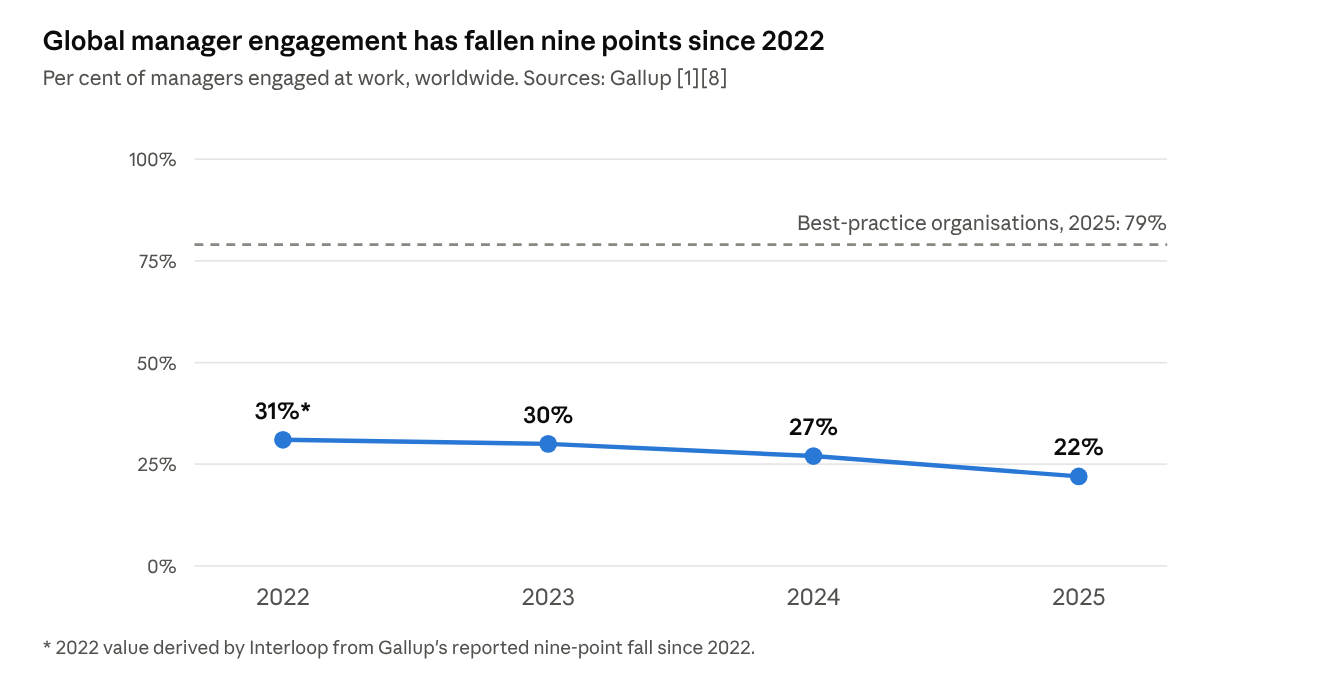
Sources: Gallup [1][8]; 2022 value derived by Interloop.
The best-practice line is the important one. The same pressures exist in every organisation, but some still keep four in five managers engaged. That gap is the space this paper is about.
Why the squeeze is happening now
Flatter structures and wider spans
Gallup points to evidence that India's IT sector slowed hiring sharply in 2025 and cut mid-level and senior roles, possibly driven in part by AI adoption, and notes that fewer managers usually means larger teams [1]. Its research on US managers finds that manager engagement declines as spans of control grow, although manager talent and training can offset the effect [1]. Deloitte describes the same global trend: organisations are reducing middle-management layers in pursuit of efficiency and agility [6]. Unsurprisingly, 47 per cent of managers told Gartner they are working harder than they were a year ago [5].
The emotional cost of leading
Leadership brings more voice and status, but also harder days. Compared with individual contributors, leaders are substantially more likely to say they felt a lot of stress, anger, sadness and loneliness the previous day [2]. Managers are more likely to be thriving in their overall lives (40 per cent, against 32 per cent of individual contributors), but they also report more daily loneliness [2].
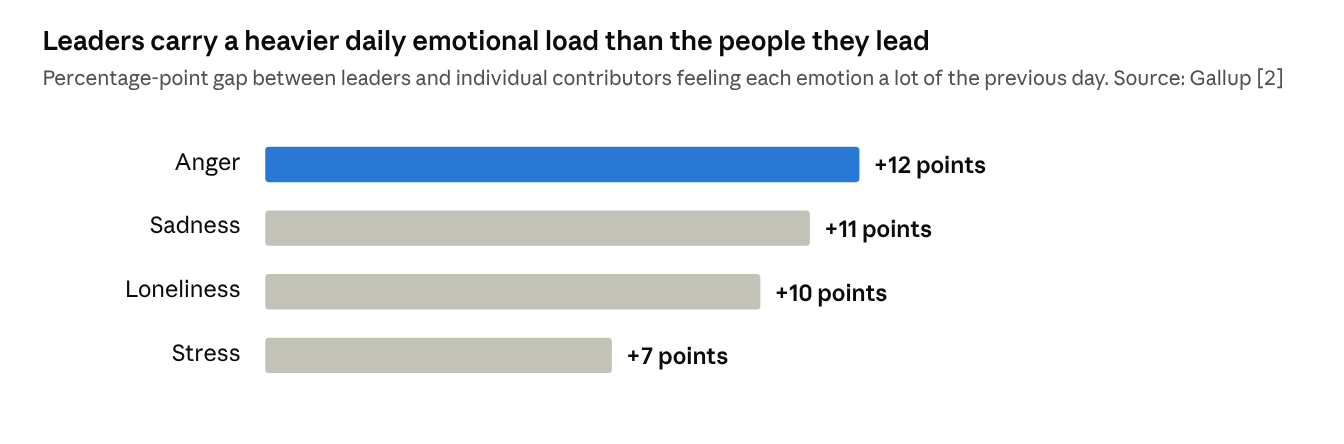
Source: Gallup [2].
Engagement changes this picture. When managers are engaged, they report every negative emotion at lower rates than individual contributors, and they are 14 points more likely to be thriving than the average leader [2]. In other words, an engaged manager is not just more productive; the job itself feels different.
AI lands on the manager's desk
Gallup's US data show that the two biggest drivers of frequent AI use inside organisations are integration with existing systems and manager-led adoption [1]. Employees who strongly agree that their manager actively supports their team's use of AI are 8.7 times as likely to strongly agree that AI has transformed how work gets done, and 7.4 times as likely to say it gives them more chances to do what they do best [1]. Yet fewer than a third of employees in organisations implementing AI say their manager offers that support [1], and only 8 per cent of HR leaders believe their managers have the skills to use AI effectively [4]. Managers are also short of information: in Deloitte's 2026 research, only 11 per cent of managers strongly agree that their organisation gives them the data and tools to decide well how work is distributed [9].
What the skills data say about managers
The people skills that define good management are becoming more valuable, not less. Employers surveyed by the World Economic Forum see leadership and social influence as a core skill for their workforce in 61 per cent of cases, empathy and active listening in 50 per cent, and talent management in 47 per cent; leadership and talent management are also among the skills expected to grow fastest in importance to 2030 [3]. As AI takes over more routine work, the human side of managing becomes a larger share of the job.
Designing the manager role: a practical playbook
In our experience, the organisations that keep managers engaged do not rely on goodwill. They design the role [7].
What it means for India and the UAE
India. Rapid growth, early promotion and flattening structures make the manager squeeze sharper in India than almost anywhere, and South Asia recorded the steepest fall in manager engagement in 2025 [1]. In our client work, we often see first-time managers taking on a team with little preparation while still carrying their own individual targets [7]. Designing the role properly is one of the highest-return investments an Indian employer can make.
UAE. Managers in the UAE often lead teams drawn from many nationalities, on different contracts and visa categories. That makes consistent, fair management harder and more important at the same time. Clear expectations and common processes help managers treat everyone the same way, which protects the high levels of trust UAE employees place in their employers, as we discuss in The UAE Talent Market.
About this research
Method. This paper is a synthesis of published research and Interloop's practitioner view. Figures were checked against the full text of Gallup's State of the Global Workplace: 2026 Report and the World Economic Forum's Future of Jobs Report 2025, and against the original Gartner and Deloitte releases. Each statistic is numbered in the text and listed under References.
Limitations. Several Gallup findings on managers and AI come from US data and are labelled as such. Global and regional figures may not reflect any single organisation, sector or city.
Credits, copyright and permissions
© 2026 Interloop Consulting. All rights reserved. You may share this paper in full, with credit to Interloop. Please do not edit it, use excerpts commercially or republish it without our written permission.
Third-party research. Statistics from other organisations are quoted for research, commentary and review, and remain the property of their publishers. Every exhibit in this paper is Interloop's own visualisation of published figures; none reproduces an original chart. Where we have derived a figure, the exhibit says so.
References (9)
- [1]Gallup (2026). State of the Global Workplace: 2026 Report, pp. 7–9 (manager engagement, India IT sector, spans of control, best-practice organisations, US data on managers and AI). Copyright © 2026 Gallup, Inc. gallup.com
- [2]Gallup (2026). State of the Global Workplace: 2026 Report, pp. 15 and 19–23 (emotions and wellbeing by leadership level and job level). gallup.com
- [3]World Economic Forum (2025). Future of Jobs Report 2025, Figure 3.3, p. 35, and Figure 3.4, p. 37. © 2025 World Economic Forum. weforum.org
- [4]Gartner (2025). "Gartner Research Finds Only 8% of HR Leaders Believe Their Managers Have the Skills to Effectively Use AI." Press release, 8 October 2025. gartner.com
- [5]Gartner (2026). "Gartner HR Survey Finds 47% of Managers Say They Are Working Harder Than One Year Ago." Press release, 29 April 2026. gartner.com
- [6]Deloitte (2025). 2025 Global Human Capital Trends. Press release, 24 March 2025. deloitte.com
- [7]Interloop Consulting (2026). Interloop analysis, based on client engagements and internal practitioner discussions, October 2026.
- [8]Gallup (2025). State of the Global Workplace: 2025 Report, Executive Summary (manager engagement, 2023 to 2024). gallup.com
- [9]Deloitte (2026). 2026 Global Human Capital Trends: From tensions to tipping points, "The orchestration advantage", p. 42. Deloitte Insights. deloitte.com
Interloop Research Team (2026). The Manager Squeeze: Why India's Middle Layer Decides Everything. Interloop Research Series on the Future of HR, Paper 4. Interloop Consulting.
This paper is for general information only and does not constitute professional advice. Figures are as published at the time of writing, October 2026. Interloop accepts no liability for decisions made on the basis of this paper.
Continue Reading