
Executive summary
The UAE is one of the most confident labour markets in the world. Three in four UAE employees say now is a good time to find a job, against about half globally, and 55 per cent are thriving in their lives, well above the global figure of 34 per cent [1][2]. Trust in institutions is among the highest anywhere [4], and the UAE has become one of the world's fastest adopters of AI [5].
For employers, that confidence cuts both ways. Good people have options and know it. Work is moving to technology faster than in most markets, and employers expect the skills their people need to change at least as fast as anywhere else [3]. Emiratisation targets add a legal obligation to build local talent, with rising penalties for missing them [6], and data protection law now governs how employee data is handled [7].
This paper sets out what the data say about the UAE talent market and what we believe HR leaders there, including those running teams across India and the UAE, should do about it.
Key findings
Building on our earlier work
This paper completes a pair with India's Thriving Gap, which looks at the same Gallup measures for India. It also draws on From Job Titles to Skills for skills planning and on Sovereignty in HR Tech for how employee data should be governed.
The evidence at a glance
Many Interloop clients employ people in both India and the UAE, so we show the two side by side against the global average. The contrast is sharp.
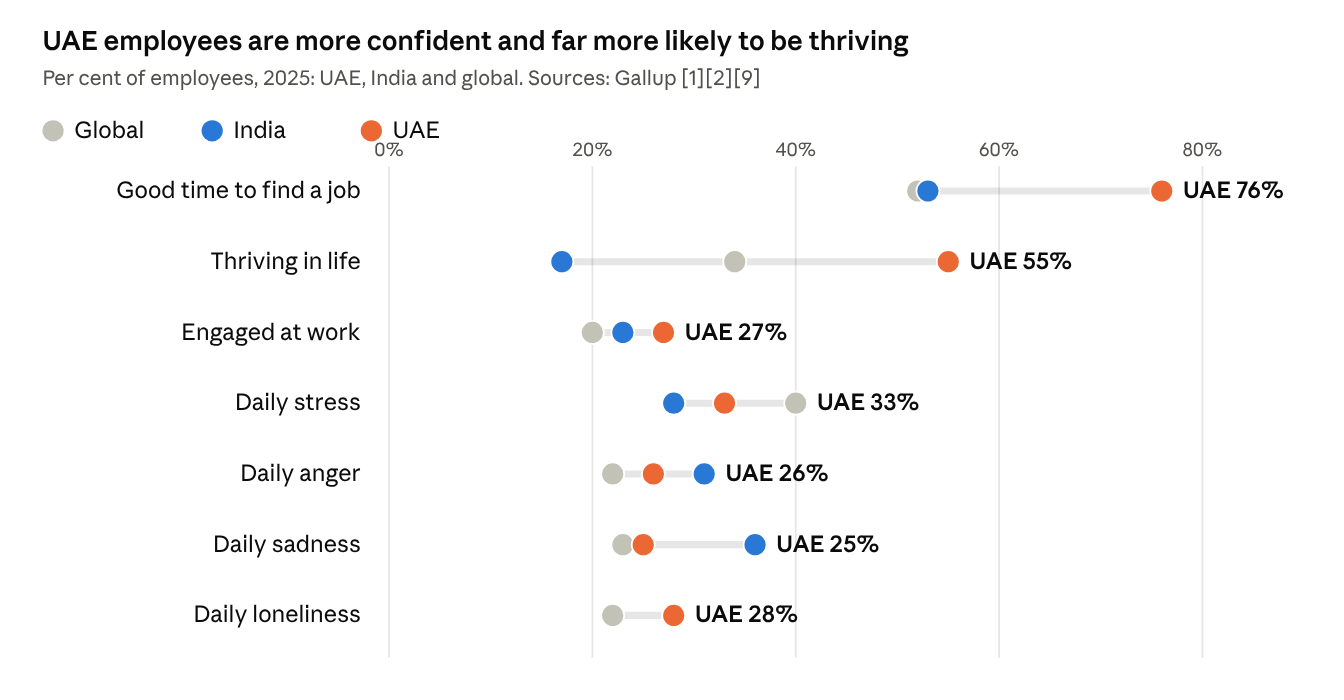
Sources: Gallup [1][2][9].
UAE employees are far more likely than Indian employees to be thriving, and far more confident about the job market [1][9]. On daily emotions the picture is more mixed: UAE employees report less stress than the global average but a little more anger, sadness and loneliness [1][2]. Loneliness, at 28 per cent, matches India's level [1][9], which is unsurprising in a workforce where most people live far from their families.
High trust, hot jobs: what it means for retention
A confident workforce is a mobile one. Gallup finds that employees who have some choice in their work are nearly 50 per cent more likely to say it is a good time to find a job [2]; in the UAE, that confidence is already the norm. Employers cannot rely on scarcity to keep people.
Trust is the UAE's advantage. 88 per cent of UAE employees trust their employer to do what is right, up eight points in a year and ahead of government, business, NGOs and media, while 63 per cent of people in the UAE expect the next generation to be better off, against 32 per cent globally [4]. That trust is also easy to lose. In our experience, UAE employees rarely leave over pay alone; they leave when promises about growth, fairness or flexibility are not kept [8]. Clear career paths, consistent treatment across nationalities and contract types, and managers who follow through are what turn high trust into long tenure. We discuss the manager's role in this in The Manager Squeeze.
Fast AI: the skills race
The UAE is adopting AI at a pace few countries match: Microsoft's research puts the share of the working-age population using AI at 70.1 per cent in early 2026, the highest in the world [5]. Employers expect that to reshape work quickly.
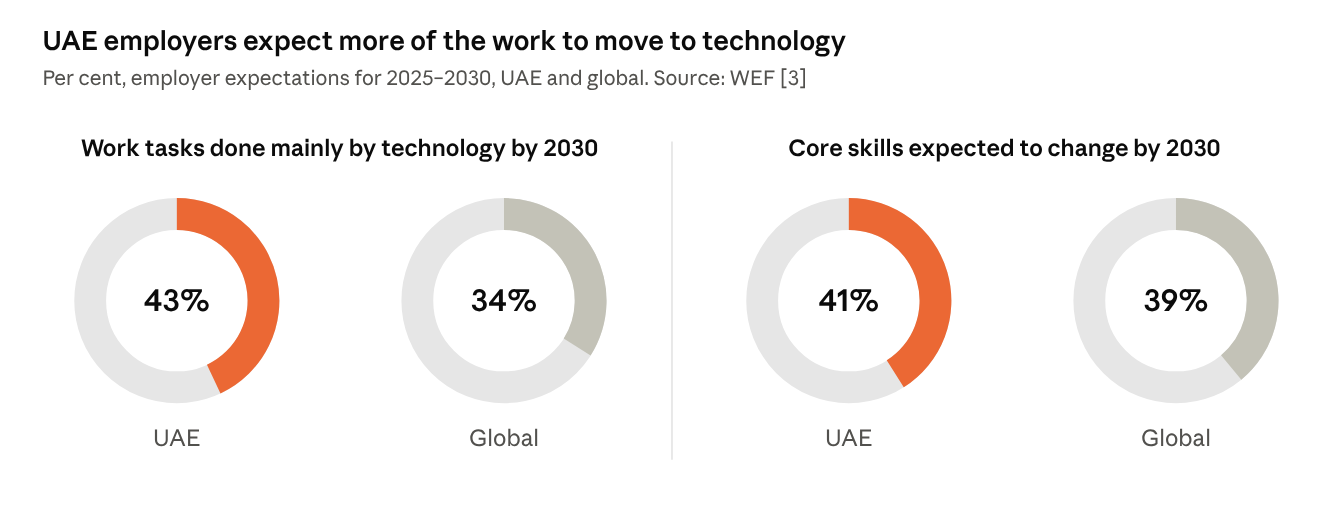
Source: WEF [3].
UAE employers expect slightly more of their workers' core skills to change than the global average, and a much larger share of tasks to move to technology [3]. Technological literacy is the skill they most expect to grow, named by 87 per cent, followed by AI and big data, networks and cybersecurity, and leadership and social influence [3]. For HR, that means AI skills must be built across the whole workforce, not left to a technology team, and that leadership skills matter as much as technical ones.
Emiratisation: a talent strategy, not only a quota
The UAE's Emiratisation rules set clear targets for private-sector employers [6]:
| Employer size | Requirement | Consequence of missing it |
|---|---|---|
| 50 or more employees | Raise the Emirati share of skilled roles by 2 per cent a year, reaching 10 per cent by the end of 2026 | A monthly contribution of AED 6,000 for each Emirati not employed, rising by AED 1,000 each year |
| 20 to 49 employees in 14 specified sectors | Employ at least one Emirati in 2024 and another in 2025 | Fines of AED 96,000 (from January 2025) and AED 108,000 (from January 2026) |
Summary of rules published on the UAE government portal [6]. Employers should confirm current requirements with the Ministry of Human Resources and Emiratisation.
Treated purely as compliance, Emiratisation becomes a hiring exercise that ends once the number is met. Treated as a talent strategy, it becomes a pipeline: early-career programmes, mentoring, clear progression and skills plans that build Emirati leaders for the long term. The skills-based approach we set out in From Job Titles to Skills applies directly.
Employee data in the UAE
The UAE's federal data protection law, Federal Decree-Law No. 45 of 2021, governs the processing of personal data and sets requirements for transferring it outside the country; financial free zones such as the DIFC have their own data protection laws [7]. For employers that run HR across India and the UAE, two regimes now apply to the same employee data processes. The principles we describe in Sovereignty in HR Tech, knowing where data sits, who can reach it and under which law, apply in both countries.
What HR leaders in the UAE should do
About this research
Method. This paper is a synthesis of published research and Interloop's practitioner view. Figures were checked against the full text of Gallup's State of the Global Workplace: 2026 Report, including its country pages for the UAE and India, the World Economic Forum's Future of Jobs Report 2025, and the UAE government portal. Edelman figures were checked against the full 2026 Edelman Trust Barometer UAE report; Microsoft figures are as reported by Khaleej Times. Each statistic is numbered in the text and listed under References.
Limitations. Gallup's UAE sample covers the working population as a whole, which in the UAE is largely expatriate; results may differ between Emirati and expatriate employees and between emirates. The World Economic Forum figures reflect employer expectations. Regulatory summaries are for orientation only and are not legal advice.
Credits, copyright and permissions
© 2026 Interloop Consulting. All rights reserved. You may share this paper in full, with credit to Interloop. Please do not edit it, use excerpts commercially or republish it without our written permission.
Third-party research. Statistics from other organisations are quoted for research, commentary and review, and remain the property of their publishers. Every exhibit in this paper is Interloop's own visualisation of published figures; none reproduces an original chart.
References (9)
- [1]Gallup (2026). State of the Global Workplace: 2026 Report, country page for the United Arab Emirates, p. 178. Copyright © 2026 Gallup, Inc. gallup.com
- [2]Gallup (2026). State of the Global Workplace: 2026 Report, pp. 11 and 18–23 (global job-market confidence, engagement, wellbeing and daily emotions). gallup.com
- [3]World Economic Forum (2025). Future of Jobs Report 2025, Figure 3.2, p. 34, and pp. 68–69 (United Arab Emirates). © 2025 World Economic Forum. weforum.org
- [4]Edelman (2026). 2026 Edelman Trust Barometer: UAE Report, pp. 5, 10, 35 and 36 (Trust Index, next-generation optimism, trust in institutions and in employers). edelman.com
- [5]Microsoft AI Economy Institute (2026). AI Diffusion Report, Q1 2026 findings, as reported by Khaleej Times, 11 May 2026. khaleejtimes.com
- [6]UAE Government (2026). "Emiratis' employment in the private sector." The Official Portal of the UAE Government. u.ae
- [7]UAE Government (2026). "Data protection laws." The Official Portal of the UAE Government. u.ae
- [8]Interloop Consulting (2026). Interloop analysis, based on client engagements and internal practitioner discussions, October 2026.
- [9]Gallup (2026). State of the Global Workplace: 2026 Report, country page for India, p. 228. gallup.com
Interloop Research Team (2026). The UAE Talent Market: High Trust, Hot Jobs, Fast AI. Interloop Research Series on the Future of HR, Paper 7. Interloop Consulting.
This paper is for general information only and does not constitute legal or professional advice. Regulations change; confirm current requirements with the relevant UAE authority or your legal adviser. Figures are as published at the time of writing, October 2026. Interloop accepts no liability for decisions made on the basis of this paper.
Continue Reading