
Executive summary
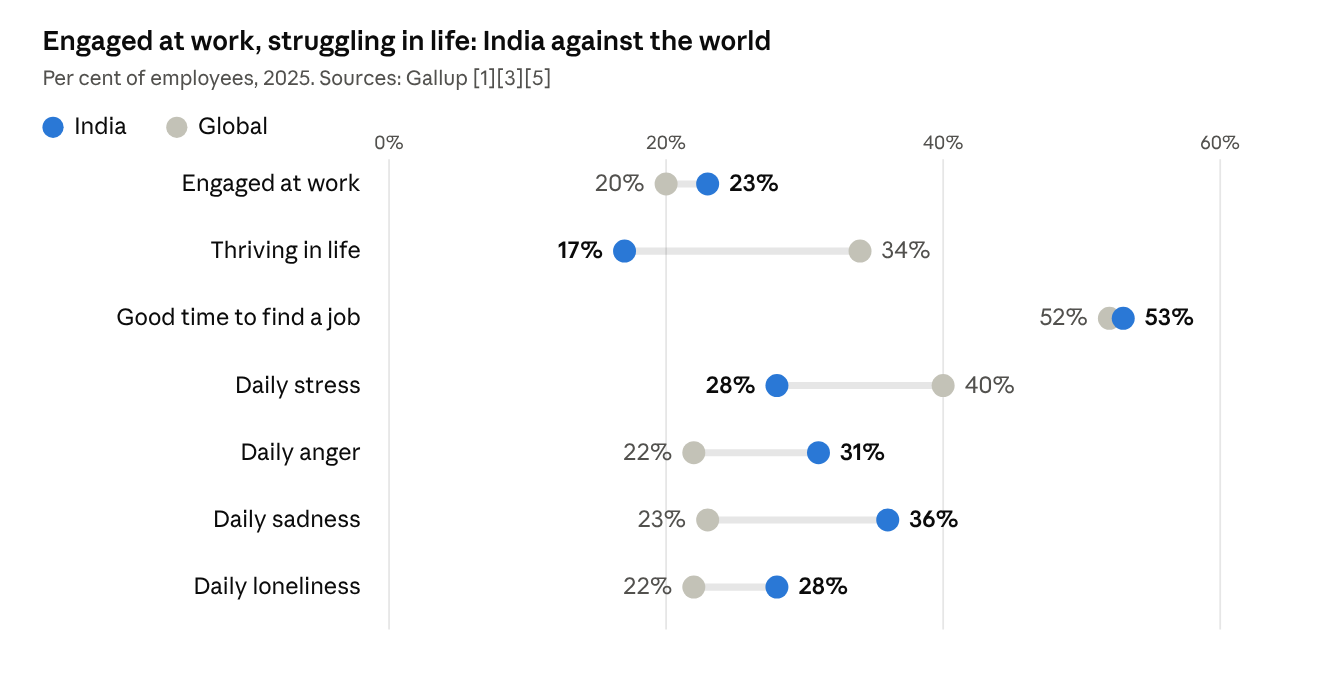
Indian employees are more engaged at work than the global average, and much less likely to be thriving in their lives. Gallup's 2026 data put India's engagement at 23 per cent, three points above the world, while only 17 per cent of Indian employees rate their lives well enough to count as thriving, half the global figure of 34 per cent [1][2]. Indian employees are also more likely than most to report a lot of sadness, anger and loneliness on any given day [1][3].
We call this India's thriving gap. It matters because engagement built on a struggling life is fragile. People can be committed to their work and still leave, burn out or quietly lower their effort when life outside work becomes too heavy. For HR, the lesson is that engagement scores alone are a flattering mirror. Wellbeing needs its own measure, its own owner and its own budget.
Key findings
Building on our earlier work
In Future HR Mandates: Who Carries Them we argued that culture and wellbeing are shared mandates that HR cannot deliver alone. In The Manager Squeeze we showed how much of the employee experience runs through the line manager. This paper looks at what that experience adds up to in India, and finds a gap that engagement surveys tend to hide.
The evidence at a glance
Gallup measures thriving through life evaluation: people rate their life today and where they expect it to be in five years, and those who rate both highly are counted as thriving [2]. It is a different question from engagement, which asks about the job. Set side by side, India's numbers point in opposite directions.
Sources: Gallup [1][3][5].
Two things stand out. First, the gap in thriving is the widest of any measure in the chart. Second, Indian employees are about as confident as the world that now is a good time to find a job (53 per cent, against 52 per cent) [1][5]. A workforce that is engaged, unhappy and confident about the job market is a workforce with options.
A regional pattern, not only a national one
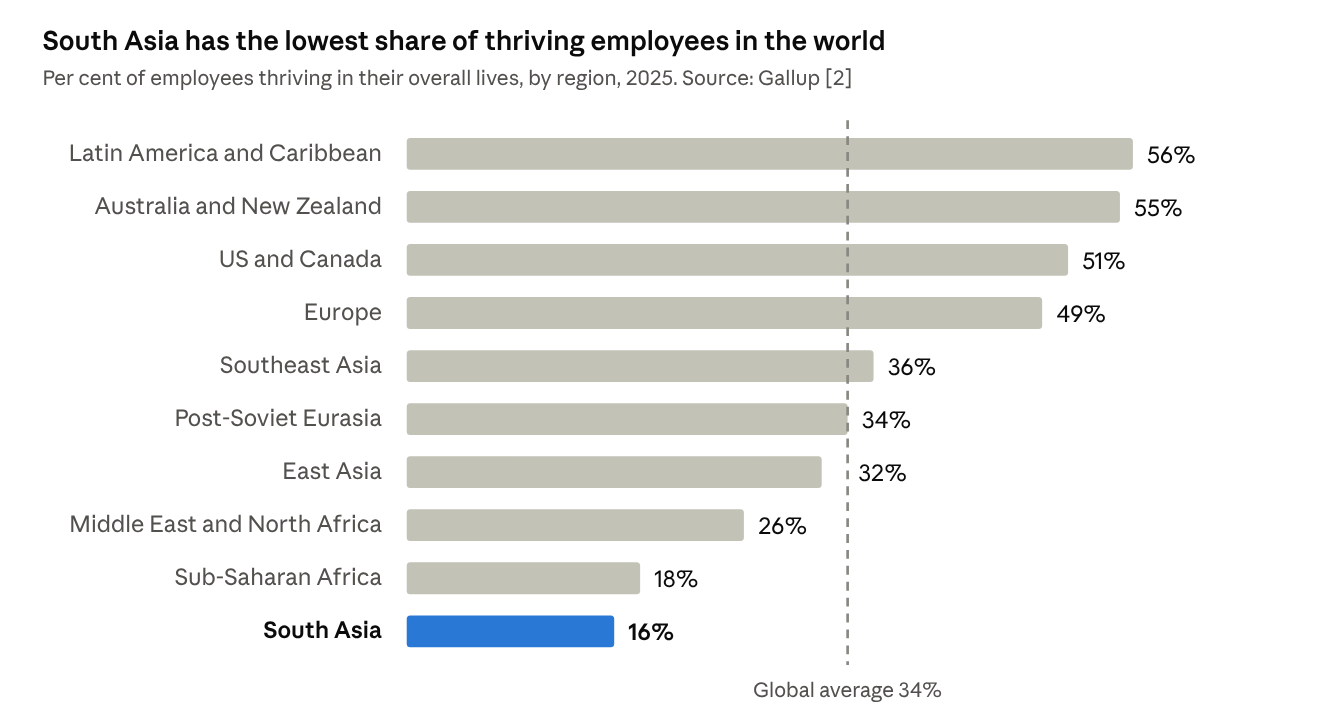
India is not alone. South Asia, where India accounts for most of Gallup's regional sample, sits at the bottom of the world on thriving [2]. Engagement in South Asia also fell five points in 2025, to 21 per cent [3].
Source: Gallup [2].
The regional view is a useful check on easy explanations. Life evaluation is shaped by income, housing, commuting, family responsibilities and social support as much as by work [2]. Employers cannot fix all of that. But work is one of the few levers that touches every employee every day, and Gallup's data show that wellbeing improves when work is enjoyable, meaningful and offers people some choice in how it gets done [2].
Why the gap matters to employers
Engagement is less durable than it looks. An engaged employee who is struggling in life is closer to the edge than the engagement score suggests. In our client work, we often hear exit interviews describe a good job that simply became unsustainable alongside family, commuting or financial pressure [7].
Retention is getting harder everywhere. Employers surveyed by the World Economic Forum have become much less optimistic about keeping talent: 44 per cent expect retention to improve, down from 53 per cent two years earlier [4]. Wellbeing is one of the few levers they consistently name to improve the supply of talent [4].
The managers are carrying it. Low mood, loneliness and personal strain first show up in a team, not in a dashboard. As we set out in The Manager Squeeze, managers are themselves under strain, which makes it harder for them to notice and respond.
It is a data question too. Measuring wellbeing means handling sensitive personal information. Any programme that asks employees about their lives needs a clear purpose, consent and careful storage, in line with the principles we describe in Sovereignty in HR Tech.
Closing the gap: what HR can do
A note on the UAE
The UAE offers a striking contrast. 55 per cent of UAE employees are thriving, well above the global figure, and 76 per cent say it is a good time to find a job [6]. For groups that employ people in both countries, the same programme will land very differently in each, which we explore in The UAE Talent Market.
About this research
Method. This paper is a synthesis of published research and Interloop's practitioner view. Figures were checked against the full text of Gallup's State of the Global Workplace: 2026 Report, including its country pages for India and the UAE, and the World Economic Forum's Future of Jobs Report 2025. Each statistic is numbered in the text and listed under References.
Limitations. Country figures come from national samples of employed adults and carry margins of error; small differences should be read with care. Gallup's data describe the working population as a whole, not any one employer, sector or city. Our explanations of why the gap exists are interpretation, not findings from the data.
Credits, copyright and permissions
© 2026 Interloop Consulting. All rights reserved. You may share this paper in full, with credit to Interloop. Please do not edit it, use excerpts commercially or republish it without our written permission.
Third-party research. Statistics from other organisations are quoted for research, commentary and review, and remain the property of their publishers. Every exhibit in this paper is Interloop's own visualisation of published figures; none reproduces an original chart.
References (7)
- [1]Gallup (2026). State of the Global Workplace: 2026 Report, country page for India, p. 228. Copyright © 2026 Gallup, Inc. gallup.com
- [2]Gallup (2026). State of the Global Workplace: 2026 Report, pp. 14–15 and 19 (wellbeing, life evaluation and thriving by region). gallup.com
- [3]Gallup (2026). State of the Global Workplace: 2026 Report, pp. 18 and 20–23 (engagement and daily emotions, global and regional). gallup.com
- [4]World Economic Forum (2025). Future of Jobs Report 2025, p. 6 (wellbeing as a talent strategy) and p. 50 (talent retention outlook). © 2025 World Economic Forum. weforum.org
- [5]Gallup (2026). State of the Global Workplace: 2026 Report, p. 11 (job-market confidence). gallup.com
- [6]Gallup (2026). State of the Global Workplace: 2026 Report, country page for the United Arab Emirates, p. 178. gallup.com
- [7]Interloop Consulting (2026). Interloop analysis, based on client engagements and internal practitioner discussions, October 2026.
Interloop Research Team (2026). India's Thriving Gap: Engaged at Work, Struggling in Life. Interloop Research Series on the Future of HR, Paper 5. Interloop Consulting.
This paper is for general information only and does not constitute professional, medical or psychological advice. Figures are as published at the time of writing, October 2026. Interloop accepts no liability for decisions made on the basis of this paper.
Continue Reading