
Executive summary
In our earlier paper, we argued that HR's future work rests on five mandates, and that most growing companies take them on in the wrong order. This paper looks at what AI and digital transformation are doing to each of those mandates. In our view, AI does not replace any of the five. It changes what each one asks of HR, and it raises the cost of leaving the design mandates without an owner.
The speed of change is the first thing to note. Gartner's surveys show generative AI adoption in HR functions rising from 19 per cent in 2023 to 61 per cent in 2025 [2], and Gartner expects half of today's HR activities to be automated or handled by AI agents by 2030 [1]. Readiness has not kept pace. The share of C-suite leaders who feel well prepared for working alongside AI has fallen from 65 per cent in 2024 to 51 per cent in 2026 [3].
Across the five mandates, we see the shift as follows:
For growing companies in India and the UAE, the message is a practical one. Employees in both markets are already using AI at work, often with tools their employer did not provide. Adoption is happening anyway. What is still open is whether HR will shape how it happens.
Key findings
Building on our earlier work
This is the second paper in our series on the future of HR. The first, Future HR Mandates: Who Carries Them, sets out the five mandates, explains the difference between design and stewardship work, and introduces our coverage model, which shows how well each mandate is usually owned at three stages of company growth.
If you have not read it yet, we would suggest starting there. This paper takes the five mandates as its base and looks at how each one is changing under AI.
The evidence at a glance
The research we reviewed points to one gap above all others. People are taking up AI far faster than organisations are preparing for it.
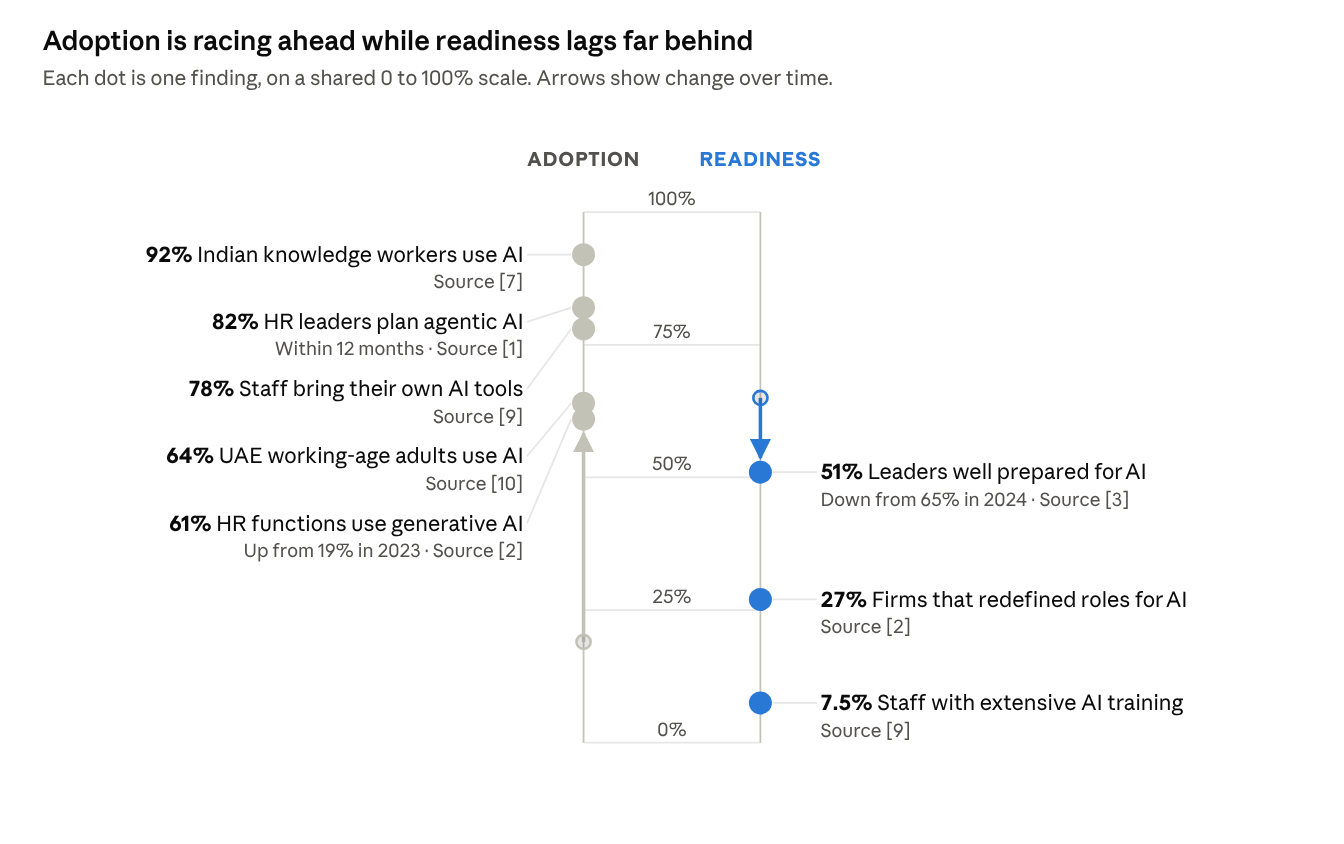
Sources: as numbered, listed under References.
The adoption numbers are high everywhere we looked, and highest in our two home markets. The readiness numbers are low, and in the case of leadership confidence, falling. This gap is where HR's five mandates now do their work.
How AI is changing each mandate
None of the five mandates goes away. Each one, though, is asking something new of HR.
1. Shape the organisation
Microsoft's 2025 Work Trend Index describes the rise of the "frontier firm", where people and AI agents work in the same teams, and suggests leaders will soon need to track a human-agent ratio alongside headcount [5]. It reports that 71 per cent of workers at such firms say their company is thriving, against 37 per cent globally [5]. The change has already started. In a Gartner survey of 114 HR leaders, 27 per cent said their organisation had redefined roles because of AI in the past year, and 24 per cent had moved employees into new positions [2]. Employers worldwide are planning for more: half intend to reorient their business in response to AI, two-thirds plan to hire talent with specific AI skills, and 40 per cent expect to reduce their workforce where AI can automate tasks [17].
What it means for HR: organisation design now has to cover digital workers too. Someone needs to decide which tasks go to agents, who supervises them, and how a manager's span changes when the team includes both people and agents. In a growing company, these decisions get made by default, team by team, unless HR takes ownership of them.
2. Build how work runs
This is where AI is moving the fastest. Gartner reports that 82 per cent of HR leaders plan to deploy agentic AI within 12 months, and projects that half of current HR activities will be automated or performed by AI agents by 2030 [1]. At the same time, Gartner predicts that more than 40 per cent of agentic AI projects will be cancelled by the end of 2027 because of escalating costs, unclear business value or inadequate risk controls [4].
Value is also slow to show up. In October 2025, 88 per cent of HR leaders told Gartner their organisations had not yet realised significant business value from AI tools [16].
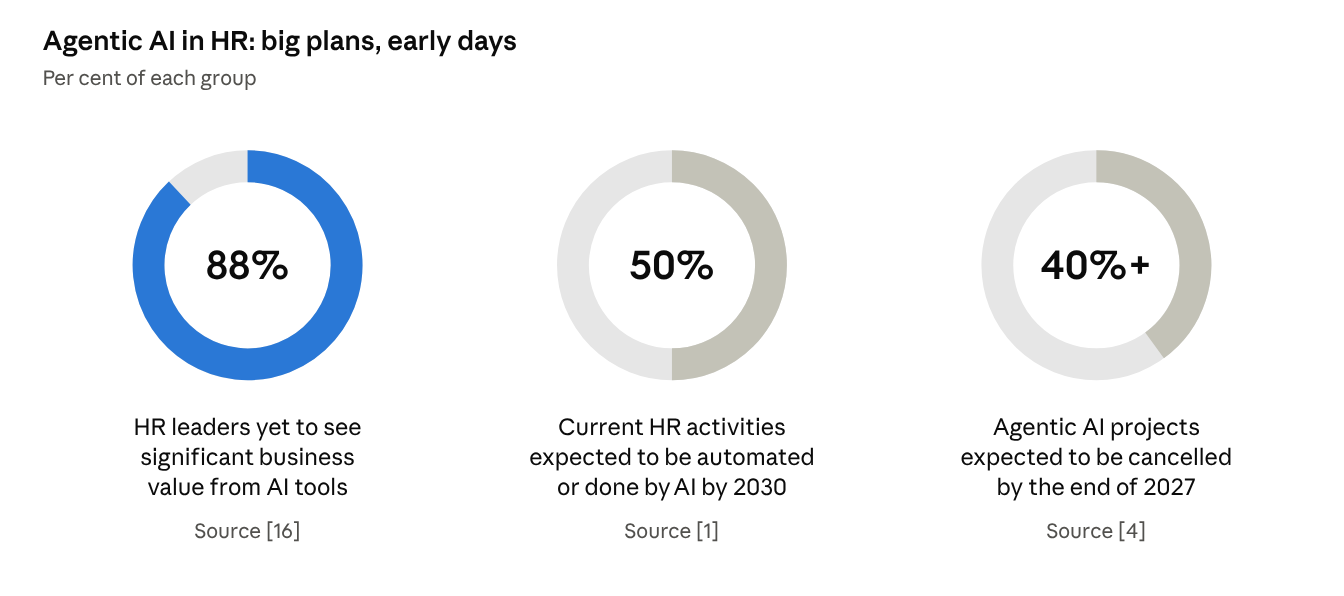
Sources: Gartner [1][4][16].
What it means for HR: putting an agent on top of a messy process only makes the mess run faster. The groundwork has not changed: clean employee data, clear approval rules and well-defined workflows. Companies that already run leave, attendance and onboarding properly in a well-set-up HR system are far better placed to add AI than those still working off spreadsheets and email.
3. Grow capability
LinkedIn expects 70 per cent of the skills used in most jobs to change by 2030, with AI as the main driver [6]. The World Economic Forum puts it another way: if the world's workforce were 100 people, 59 would need training by 2030. Of these, 29 could be upskilled in their current roles and 19 could be upskilled and redeployed elsewhere in their organisation, but 11 would be unlikely to receive the training they need [17]. Employers name skill gaps as the single biggest barrier to business transformation, with 63 per cent citing them [17].
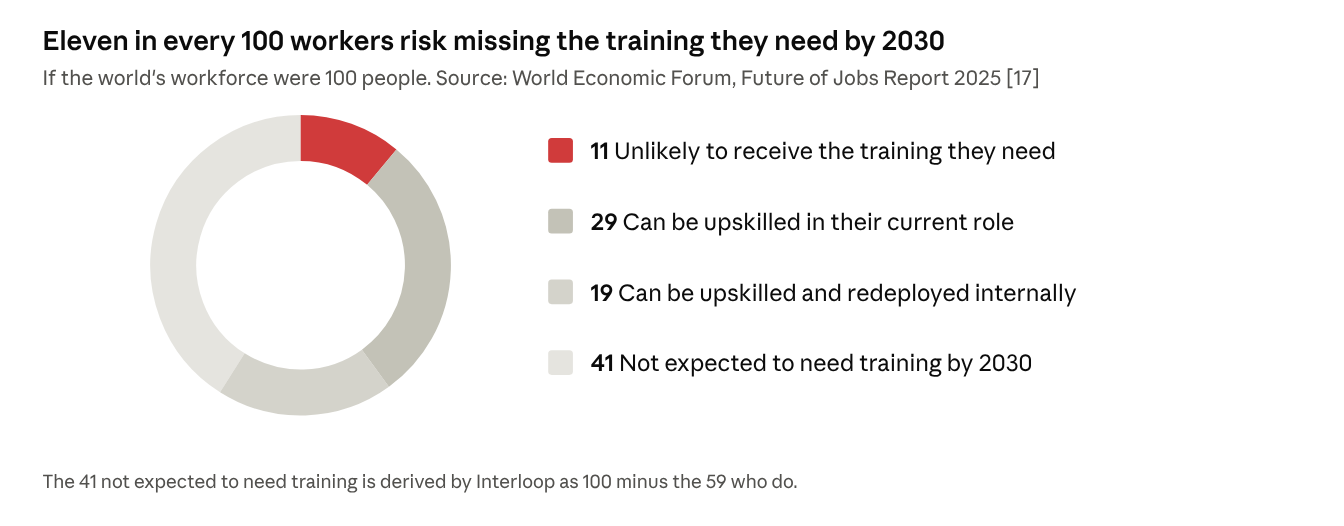
Source: World Economic Forum [17]; the 41 not needing training is derived by Interloop.
In India, 80 per cent of leaders say they would rather hire a less experienced candidate with AI skills than a more experienced one without them [7]. Training, however, is far behind usage: in one 2025 US survey, only 7.5 per cent of employees had received extensive AI training [9].
What it means for HR: hiring alone cannot close a gap that moves this fast. Capability has to be built on the job, continuously, and tracked as skills rather than titles. The learning agenda also needs a new set of basics: how to work with AI, how to check what it produces, and when not to use it at all.
4. Carry culture and experience
Employees are not waiting for permission. In a 2025 US survey, 78 per cent of workers said they use AI tools their employer did not provide [9], and in India, 72 per cent of knowledge workers bring their own AI tools to work [8]. This is as much a culture issue as a technology one. When people work around official tools, managers lose sight of how work is actually being done, and employees are left unsure how their AI use will be judged.
Gallup's 2026 research shows how much depends on the manager. In US organisations investing in AI, employees who strongly agree that their manager actively supports their team's use of AI are 8.7 times as likely to strongly agree that AI has transformed how work gets done. Yet fewer than a third of employees in organisations that have begun implementing AI say their manager offers that support [18].
What it means for HR: culture in the AI era rests on psychological safety. People need to know that using AI well will be valued, that they will be trained, and that decisions about their roles will be made openly. Managers carry most of this load, which brings us back to the manager strain we described in our first paper, Future HR Mandates: Who Carries Them.
5. Guard trust and fairness
The rules are catching up. India notified its Digital Personal Data Protection Rules in November 2025 with an 18-month phased compliance timeline [11], which brings the main obligations into force in May 2027 [12]. Companies that recruit or assess people in Europe also face the EU AI Act, which treats recruitment and employee-evaluation AI as high-risk. Following the EU's June 2026 simplification package, obligations for stand-alone high-risk systems apply from 2 December 2027 [13].
What it means for HR: HR holds some of the most sensitive personal data in any company, so these rules land squarely on HR's desk. AI governance becomes part of the day job: knowing where AI is used in people decisions, keeping a human in the loop for hiring, pay, performance and exits, and being open with employees about all of it. Where that data is stored, and who can reach it, is a question we take up in detail in Sovereignty in HR Tech: Why Employee Data Should Stay in India.
The shift at a glance
| Mandate | Before AI | In the AI era |
|---|---|---|
| Shape the organisation | Org charts, spans and reporting lines for people | Teams of people and AI agents, with clear decisions on what agents do and who supervises them |
| Build how work runs | Digitising and automating individual tasks | Redesigning whole workflows around agents, with people handling judgement and exceptions |
| Grow capability | Hiring for roles, with training once or twice a year | Continuous reskilling, hiring for skills, and AI literacy for everyone |
| Carry culture and experience | Engagement surveys and programmes | Psychological safety, openness about AI use, and managers who coach people through change |
| Guard trust and fairness | Policies and statutory compliance | Active AI governance, data protection compliance, and human review of people decisions |
The direction is the same across all five. Each mandate now needs more design and more judgement, and much less administration.
HR's own technology: busy, not yet transformative
HR functions are investing heavily in their own tools. Mercer's 2026 research finds that 67 per cent of HR leaders plan to expand self-service this year and 58 per cent plan to implement new technology for HR services [19]. The returns are less clear.
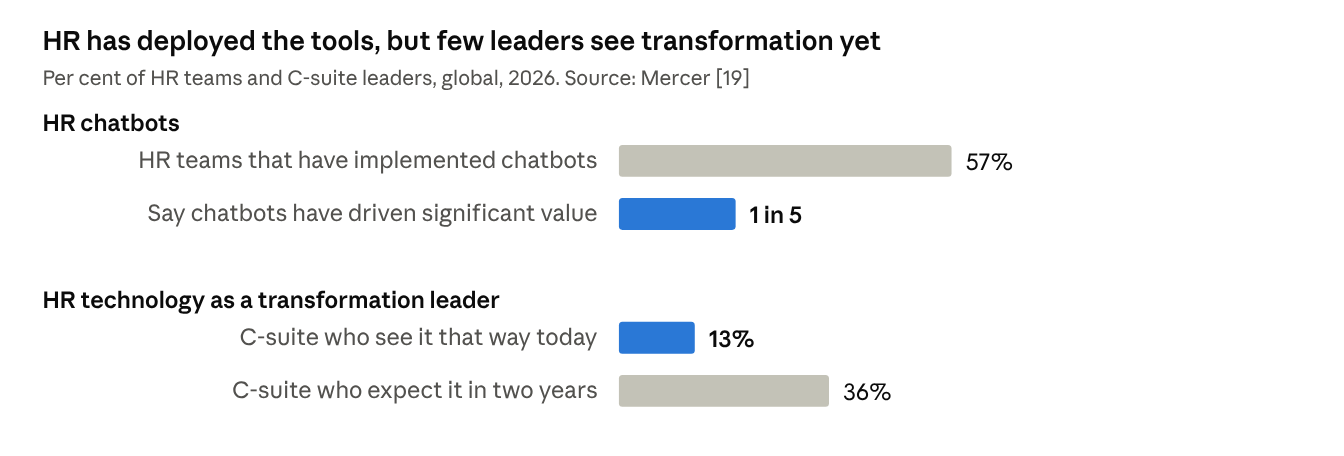
Source: Mercer [19].
More tools are not the answer on their own. 44 per cent of executives want fully integrated HR technology [19], and that matters more than the next chatbot. The bigger shift is in who runs the work: 65 per cent of HR leaders are concerned about HR's role as AI agents spread, 56 per cent expect HR and IT departments to merge, and 60 per cent of the C-suite agree the two must work as a unified force [19]. Investors notice too: 67 per cent see organisations where HR and IT work as one as more attractive investments [19]. HR teams that learn to design work with technology, rather than simply buy it, will set the terms of that convergence.
What it means for India and the UAE
India. Indian knowledge workers are among the keenest AI users anywhere: 92 per cent use AI at work, against 75 per cent globally [7]. Most of this use is self-driven, with 72 per cent bringing their own tools [8]. Leaders feel the urgency too. 91 per cent say their company needs AI to stay competitive, yet 54 per cent worry their organisation lacks a plan for it [7]. Employers in India also expect 38 per cent of workers' core skills to change by 2030 [17]. Add the DPDP compliance timeline [12], and Indian HR teams have a short window to bring some structure to AI use that is already widespread.
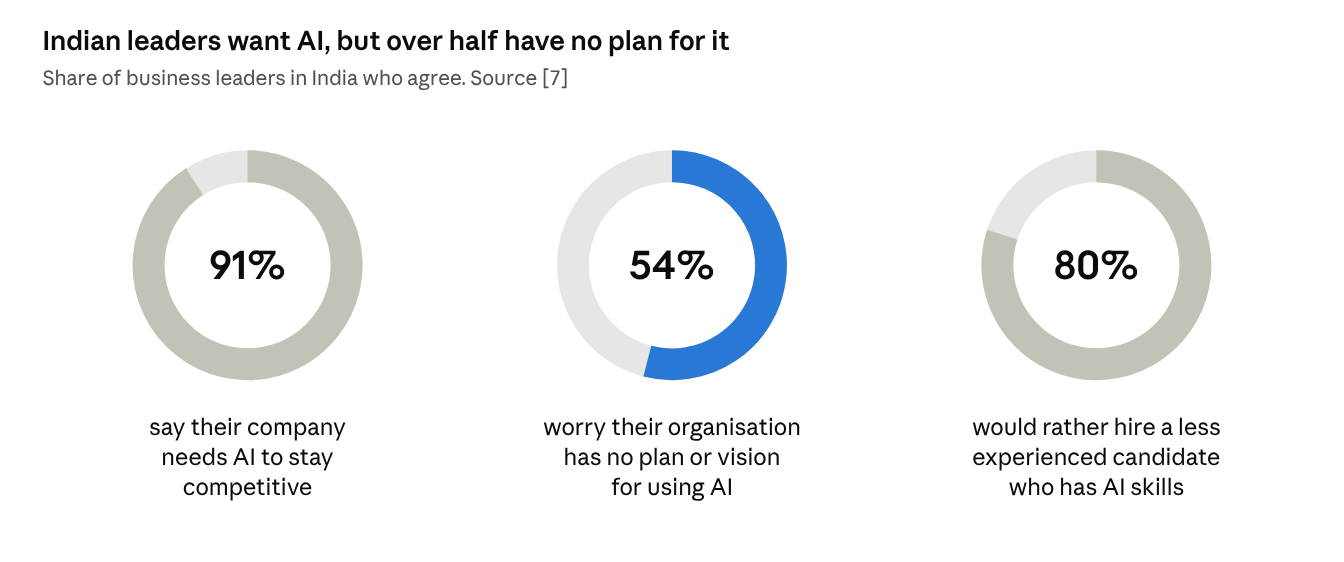
Source: Microsoft and LinkedIn, 2024 Work Trend Index [7].
The gap between wanting AI and having a plan for it is exactly where HR can lead.
UAE. The UAE leads the world in AI use, with 64 per cent of its working-age population using generative AI tools by the end of 2025 [10]. Employers there expect 41 per cent of workers' core skills to change by 2030, above the global average of 39 per cent [17]. Trust in employers is also high, as we noted in our first paper. UAE companies are therefore well placed to move quickly. The risk is moving quickly but unevenly, with different rules for different entities, nationalities or teams.
We look at the UAE market in more depth in The UAE Talent Market, and at how to plan for fast-changing skills in From Job Titles to Skills.
Both markets. In both countries, adoption is running ahead of HR's design work. For companies operating across India and the UAE, the sensible step is one set of AI and data rules that works under both regimes, built into the HR system itself rather than kept in a policy document that few people read.
Where to begin
In our experience, the companies that get this right do not start with the most advanced tools. They start by getting the basics in order.
About this research
Acknowledgement. This paper builds on our earlier research, Future HR Mandates: Who Carries Them, which was itself inspired by the Future HR Mandates: Role Contribution framework [15].
Method. This paper is a synthesis of published research, combined with Interloop's own practitioner view [14]. Between September and October 2026, we reviewed studies from Gartner, Gallup, the World Economic Forum, Mercer, Microsoft, LinkedIn, WalkMe and official sources in India and the EU, and checked each figure against its original publisher's report or release, including the full text of Gallup's State of the Global Workplace: 2026 Report and the World Economic Forum's Future of Jobs Report 2025. Where a figure is available only through a secondary report, the reference says so.
Limitations. Survey figures come from different samples, regions and years, and are shown side by side for context rather than as one dataset. Several surveys cited are US-based; we say so in the text where this applies. Legal and regulatory dates are correct as of October 2026 and may change.
Interloop Research Team
Credits, copyright and permissions
© 2026 Interloop Consulting. All rights reserved. You may share this paper in full, with credit to Interloop. Please do not edit it, use excerpts commercially or republish it without our written permission.
Third-party research. Statistics from other organisations are quoted for research, commentary and review, and remain the property of their publishers. Every exhibit in this paper is Interloop's own visualisation of published figures; none reproduces an original chart. Where we have derived or rearranged a figure, the exhibit says so.
References (19)
- [1]Gartner (2025). The Future of AI in HR: Reinventing the Operating Model. gartner.com
- [2]Gartner (2025). "Gartner Announces Top Trends Shaping HR Priorities in Australia in 2026." Press release, 17 November 2025; surveys of 197 HR leaders (June 2023 and January 2025) and 114 HR leaders (July 2025). gartner.com
- [3]Mercer (2026). Global Talent Trends 2026. Survey of nearly 12,000 executives, HR leaders, investors and employees, September to October 2025. mercer.com
- [4]Gartner (2025). "Gartner Predicts Over 40% of Agentic AI Projects Will Be Canceled by End of 2027." Press release, 25 June 2025. gartner.com
- [5]Microsoft (2025). 2025 Work Trend Index: The Year the Frontier Firm Is Born. microsoft.com
- [6]LinkedIn (2025). Work Change Report: AI Is Coming to Work. linkedin.com
- [7]Microsoft and LinkedIn (2024). 2024 Work Trend Index, India findings. Press release, 16 May 2024. microsoft.com
- [8]Microsoft and LinkedIn (2024). 2024 Work Trend Index, India findings on employees bringing their own AI tools, as reported by All Things Talent.
- [9]WalkMe (2025). AI in the Workplace Survey. US survey of 1,000 working adults, July 2025. Press release, 27 August 2025. walkme.com
- [10]Microsoft AI Economy Institute (2026). Global AI Adoption 2025. January 2026. microsoft.com
- [11]Press Information Bureau, Government of India (2025). "Government notifies DPDP Rules, 2025." Press release, 14 November 2025. pib.gov.in
- [12]Uniqus (2025). Digital Personal Data Protection Act timelines. Compliance timeline analysis, November 2025. uniqus.com
- [13]Council of the European Union (2026). "Artificial intelligence: Council gives final green light to simplify and streamline rules." Press release, 29 June 2026. consilium.europa.eu
- [14]Interloop Consulting (2026). Interloop analysis, based on client engagements and internal practitioner discussions, October 2026.
- [15]Future HR Mandates: Role Contribution (graphic). Source unknown.
- [16]Gartner (2025). "Gartner Survey Shows 88% of HR Leaders Say Their Organizations Have Not Realized Significant Business Value from AI Tools." Press release, 28 October 2025. gartner.com
- [17]World Economic Forum (2025). Future of Jobs Report 2025, pp. 5–6 and Figure 3.2, p. 34. © 2025 World Economic Forum. weforum.org
- [18]Gallup (2026). State of the Global Workplace: 2026 Report, pp. 6 and 9 (US data on AI and managers). Copyright © 2026 Gallup, Inc. gallup.com
- [19]Mercer (2026). Global Talent Trends 2026: Trend 4, Unleash a new HR era (HR operating model, technology and HR–IT findings). Marsh. marsh.com
Interloop Research Team (2026). HR in the Age of AI: What Really Changes. Interloop Research Series on the Future of HR, Paper 2. Interloop Consulting.
This paper is for general information only and does not constitute legal, financial or professional advice. Regulatory dates and figures are as published at the time of writing, October 2026, and may since have changed. Interloop accepts no liability for decisions made on the basis of this paper.
Continue Reading