Contributed by
The people closest to a process are often the last to see what is wrong with it. Open communication is how a team learns to see itself.
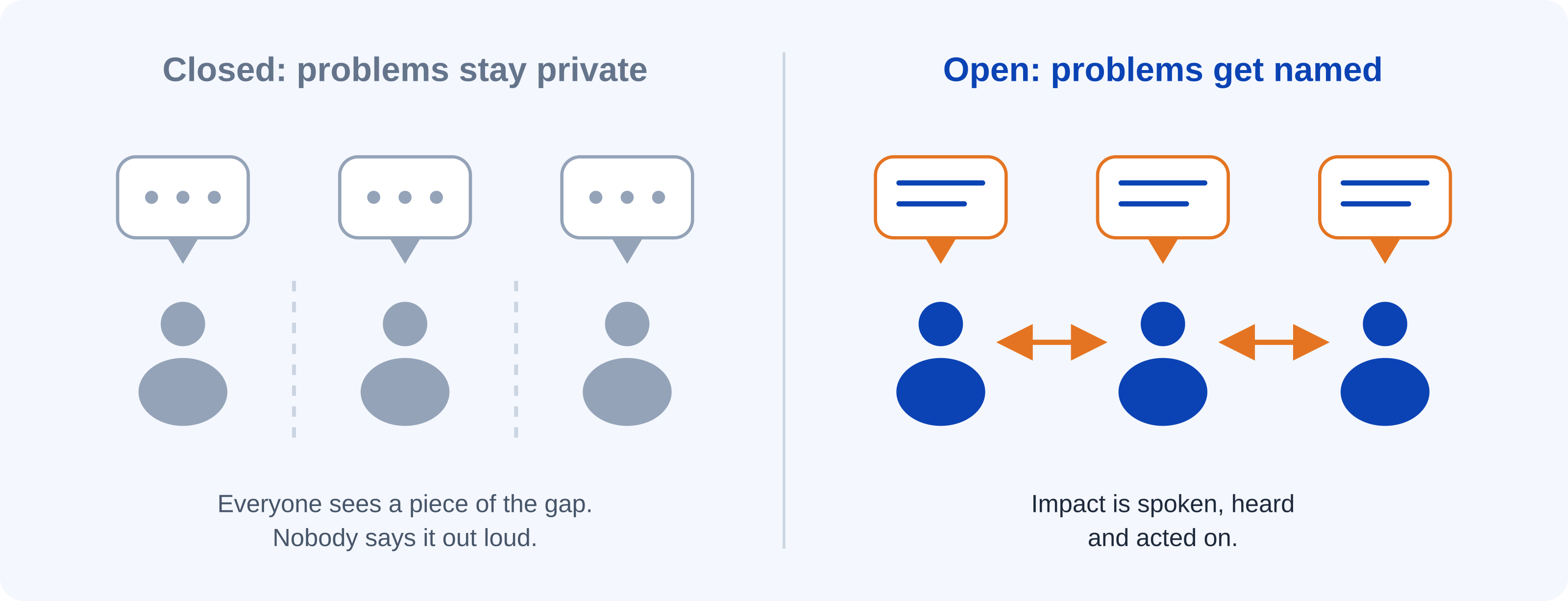
In a closed team, each person sees one piece of the problem. In an open team, the impact gets spoken, heard and acted on.
In a recent sales team meeting at Interloop, we noticed something simple. Gaps in how we work only came into view when someone paid attention to them, or described what they were costing. None of those gaps were new. We had been working around them for a while, and a workaround that is repeated long enough stops feeling like a workaround.
That is the uncomfortable truth about process problems. When you are in the middle of the work, you cannot easily see it. Pressure to hit the week’s numbers makes a gap feel like “just how we do things”, and the cost stays with it.
This is why we treat open communication as a working mechanism rather than a culture slogan. It is how a team gets a view of its own process.
“The most important thing in communication is hearing what isn’t said.”
Peter Drucker (widely attributed)
Why gaps hide from the people inside them
Three things tend to keep gaps hidden.
Everyone sees their own step. A salesperson knows the follow-up stage well. They rarely see what happens to the same lead at the handover before or after it. The gap lives in the space between two people’s views, so nobody owns it.
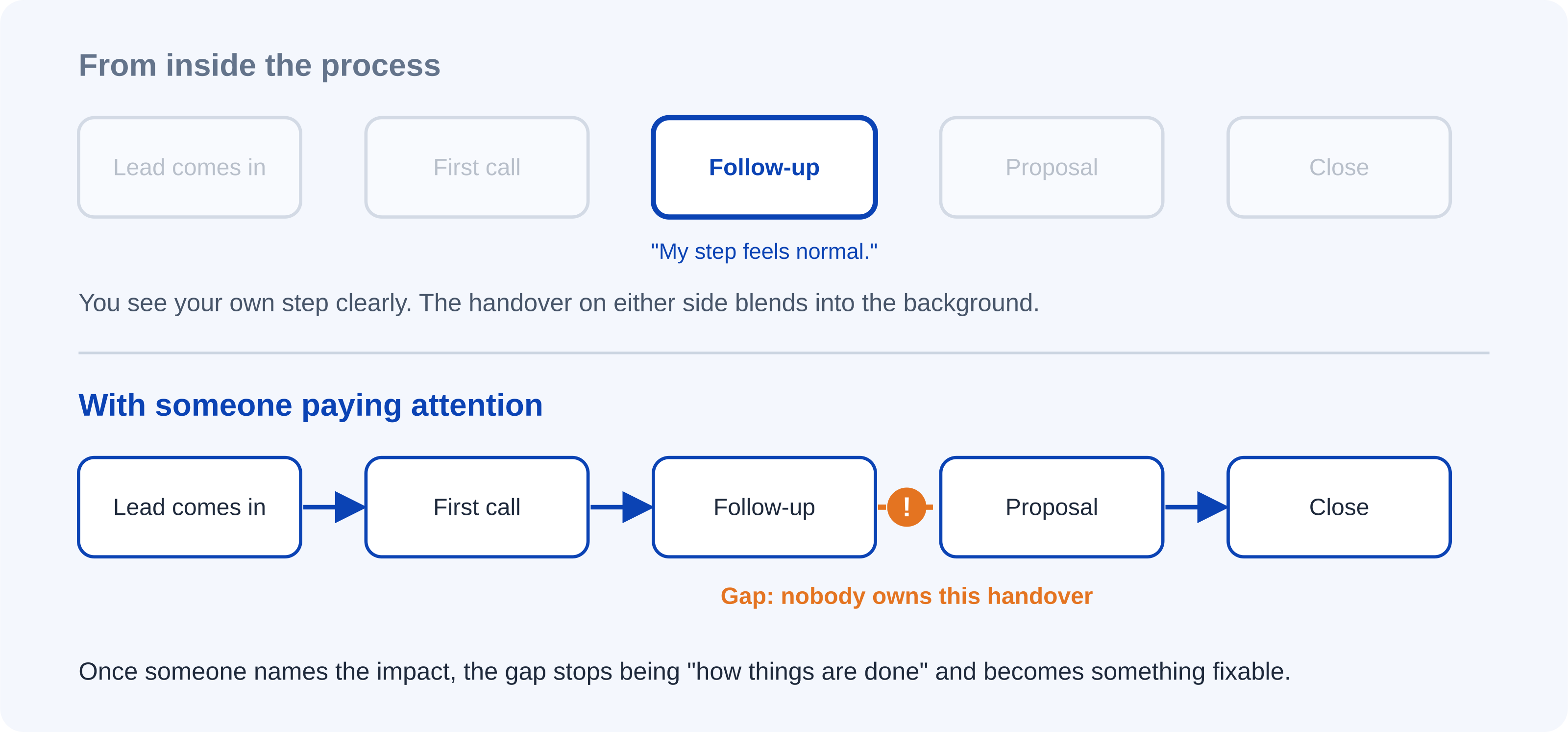
The same five-step process, seen from inside one step and then by someone paying attention to the whole.
Workarounds become the process. A spreadsheet kept on the side, a message sent “just in case”, a manual check that nobody wrote down. Each one solves a real problem, and together they hide the original problem.
Silence is a rational choice. Raising a gap can feel like admitting a mistake or criticising a colleague. If the last person who spoke up was met with defensiveness, the team learns the lesson quickly.
What open communication actually requires
It is not a policy that says “my door is always open”. It needs two habits to exist at the same time: listening properly, and being clear.
“Seek first to understand, then to be understood.”
Stephen R. Covey, The 7 Habits of Highly Effective People
Listening makes it safe to speak. Clarity makes speaking useful. A vague concern (“things feel a bit off”) gives the team nothing to fix, and a vague reply (“noted, let’s see”) tells the speaker nothing was heard.
“Clear is kind. Unclear is unkind.”
Brené Brown, Dare to Lead
Kim Scott’s Radical Candor framework puts the balance well: caring personally while challenging directly. If you only care, problems are never named. If you only challenge, people stop talking.
Six practical habits you can start this month
- Leaders go first. Before asking anyone to name a gap, name one of your own. Describe a decision you would make differently, or a process you built that is not working. It resets what is safe to say in the room.
- Hold a 15-minute “what slowed us down?” check-in every week. One question, and everyone answers. Do not solve anything in the first pass, just collect.
- Replace “any feedback?” with a sharper question. That one is usually met with silence. Try instead: “Which step in our process would you delete?” · “What do you redo every week?” · “What do customers ask that we cannot answer quickly?”
- Borrow fresh eyes. Ask a new joiner, or someone from another team, to walk through a process and say out loud where they get confused. Your own data helps too. A deal that sits in one CRM stage for weeks, or a recurring entry in a lost-reason field, is not a verdict on a person. It is a question about the process.
- Talk about impact, not blame. “When the handover happens this way, the lead waits two extra days” can be heard. “You always forget to hand over” cannot. Describe what happens to the work, and let the person respond to that.
- Close the loop, visibly. Acknowledge what was raised within a day. Decide what will change. Then report back, including when the answer is “we are not changing this, and here is why”. An unanswered concern teaches the team not to raise the next one.
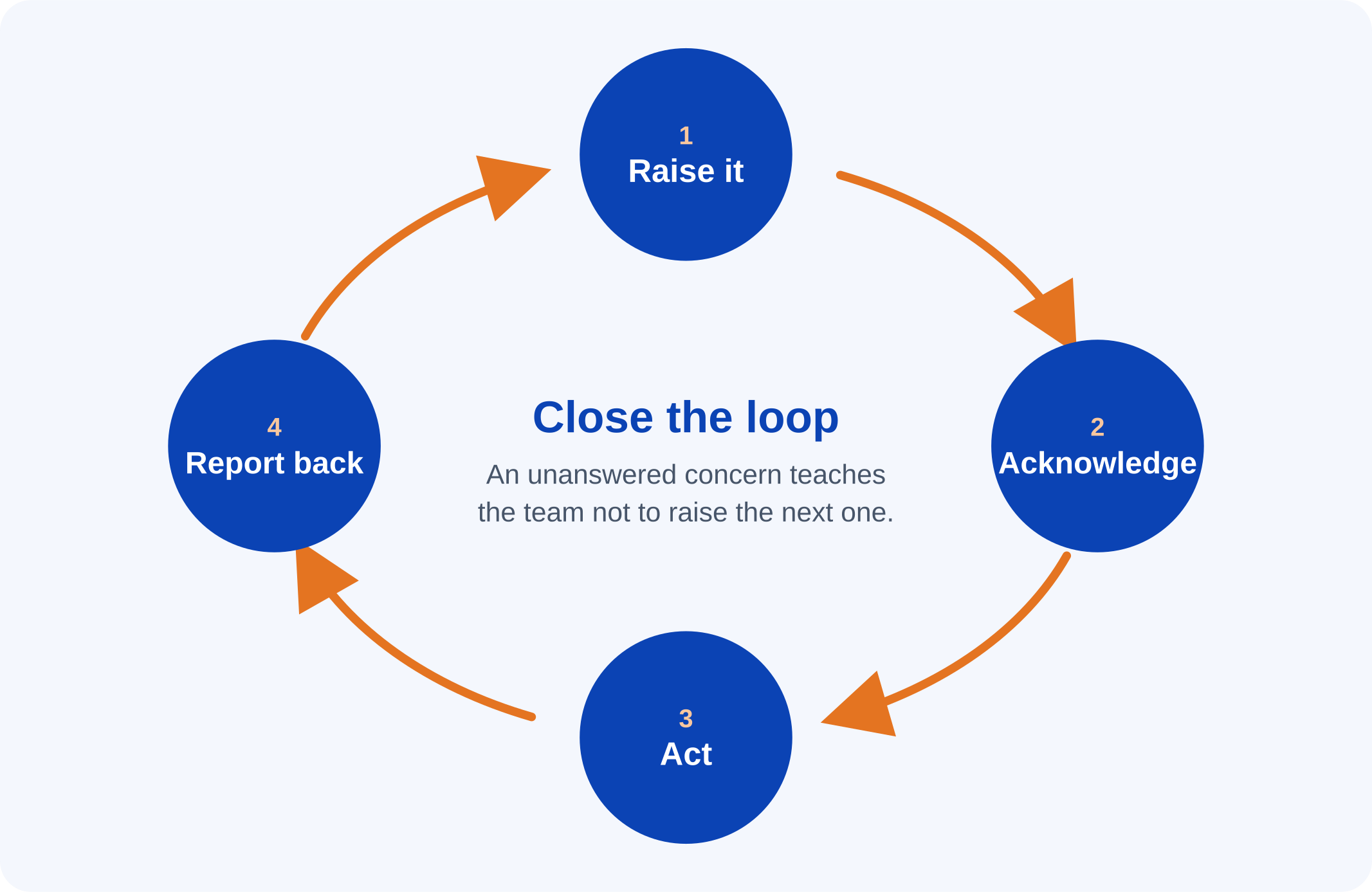
Openness holds only if every concern travels the full loop, from being raised to being reported back.
What gets in the way
A defensive reaction in the moment. One defensive reply can close a team down for months.
Treating openness as an event. An annual survey or offsite does not build the habit. A short weekly routine does.
Expecting tools to do the work. A CRM, a project board or an HRMS can show you where work stalls. None of them can make a person comfortable explaining why. We see tools help most when the conversation habit already exists, and help least when they are introduced to avoid it.
Where this leaves us
We are applying this inside our own teams, and we are not claiming a perfect process. The aim is a team that can see its own process. That matters for clients too: when a CRM or HRMS rollout is planned around the process as people describe it, rather than the process as it appears on paper, the gaps surface during discovery instead of after go-live.
Planning a rollout, or tired of the same gaps resurfacing?
If you would like to talk through how we approach discovery with sales, HR or operations teams, we would be glad to walk through your setup. Get in touch with our team
Quotes: Peter Drucker (attributed; listed in the Drucker Institute quote library), Stephen R. Covey (The 7 Habits of Highly Effective People, Habit 5), Brené Brown (Dare to Lead). Radical Candor is Kim Scott’s framework. Illustrations are original Interloop artwork.